CARDIAC · Injectable
SS-31 + Cardiogen Blend.
Combined cardiac and mitochondrial protection



Written by Beatrisse Fender & Toby Sorabjee · Reviewed by Lynn Marie Morski
Medically reviewed October 25, 2026
How it works
Class & mechanism.
In short
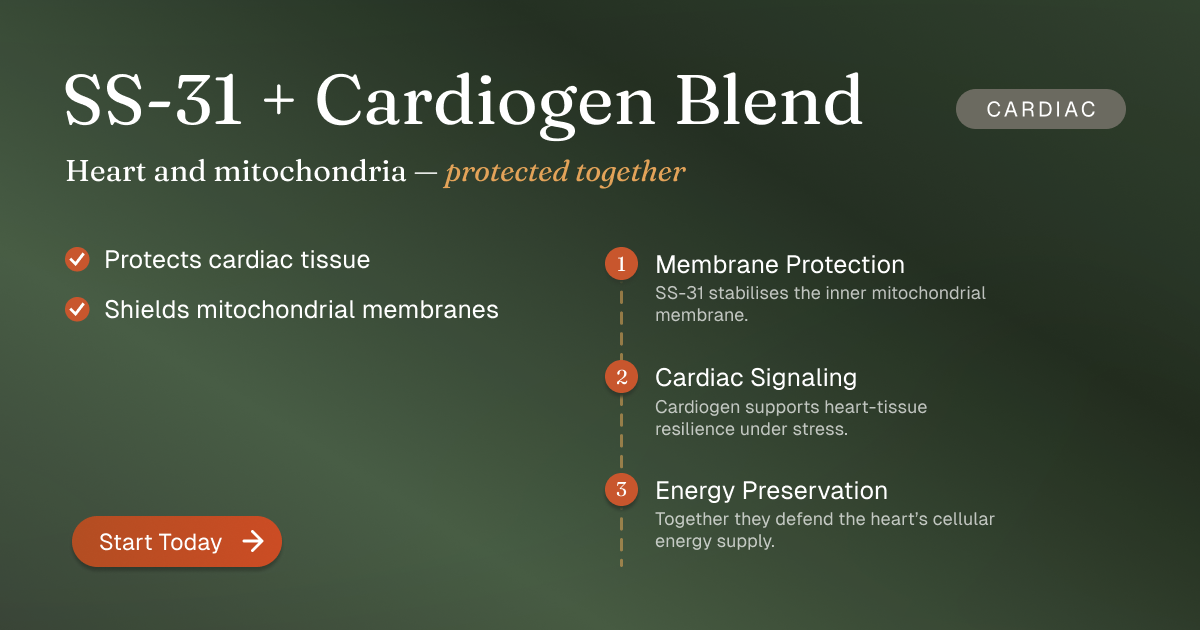
This blend pairs SS-31 (elamipretide), which protects mitochondrial energy production by stabilizing cardiolipin in heart cells, with Cardiogen, a Khavinson bioregulator peptide proposed to support cardiomyocyte survival and gene expression at the nuclear level. Together they are studied for cardiac cytoprotection at two distinct biological levels — cellular energy (mitochondria) and cell survival signaling (nucleus). SS-31 has a narrow FDA approval for Barth syndrome; Cardiogen has none, and evidence for this specific combination is preclinical and mechanistic rather than trial-confirmed.
Class
Dual Cardiac & Mitochondrial Protection Blend
Mechanism
SS-31 (Elamipretide, D-Arg-dimethylTyr-Lys-Phe-NH2) is an aromatic-cationic tetrapeptide that selectively concentrates in the inner mitochondrial membrane and binds cardiolipin — a phospholipid essential for electron transport chain architecture. By stabilizing cardiolipin-protein interactions, SS-31 is thought to preserve cristae structure, support ATP synthesis, reduce reactive oxygen species (ROS) production, and inhibit opening of the mitochondrial permeability transition pore. Cardiogen (AEDR) is proposed to complement this by acting upstream at the nuclear level, where it is thought to suppress p53-driven cardiomyocyte apoptosis and stimulate cardiac progenitor cell proliferation — per the Khavinson gene-switching model. Together the two compounds are proposed to target cardiac protection at two distinct levels: organelle bioenergetics (SS-31) and gene-regulated cell survival and repair (Cardiogen), though the combination itself has not been studied as a unit.
Personalized Peptides provides DNA-driven peptide recommendations — we are not a compounding pharmacy, peptide synthesis company, or clinical provider.
Did you know
SS-31 is so selective for damaged mitochondria that it shows virtually zero benefit in healthy, young hearts — it only activates its repair mechanism when mitochondria are already dysfunctional, making it one of the few compounds that acts as a precision tool rather than a blunt stimulant.
Benefits
What it does.
Dual-layer cardiac protection: SS-31 is thought to guard mitochondrial energy production while Cardiogen is proposed to safeguard cardiac gene expression and cell survival — two distinct, complementary mechanisms rather than a single overlapping pathway
In aged mouse models, late-life SS-31 treatment reversed pre-existing cardiac diastolic dysfunction by restoring mitochondrial integrity and reducing proton leak in cardiomyocytes — human cardiac-aging data for this specific application has not been established
May help reduce oxidative stress at its mitochondrial source, which preclinical evidence suggests could limit downstream inflammation and myocardial fibrosis, though this has not been directly studied for the combination
May support post-ischemic cardiac recovery by helping preserve viable cardiomyocyte mass and reduce pathological remodeling, based on the individual components' preclinical and clinical profiles rather than combination-specific trials
Improved exercise tolerance and cardiac stroke volume were demonstrated for SS-31 specifically in Barth syndrome clinical trials (its FDA-approved indication) through enhanced ATP availability in heart muscle — this has not been established for general or off-label use of the blend
The science
Peer-reviewed findings.
Research supporting this compound's mechanisms and safety profile.
What this does not mean
This blend combines two research-stage compounds — SS-31 and Cardiogen. The information on this page is educational and does not constitute medical advice, diagnosis, or treatment. Neither compound is FDA-approved for general cardiac, longevity, or mitochondrial support use: SS-31 holds a narrow FDA approval (FORZINITY™) solely for Barth syndrome, and Cardiogen has no Western regulatory approval of any kind. This page does not recommend, endorse, or prescribe any compound for human use. Always consult a qualified healthcare provider before making health decisions. Personalized Peptides provides DNA-driven educational context and test interpretation — not clinical protocols or pharmaceutical recommendations.
Late-life SS-31 treatment reversed pre-existing cardiac aging phenotypes including diastolic dysfunction in old mice, reducing mitochondrial ROS production and age-related proton leak in cardiomyocytes — effects absent in young mice with healthy mitochondria, confirming selective action on dysfunctional cells
SOURCE · eLife (2020) — 'Late-life restoration of mitochondrial function reverses cardiac dysfunction in old mice'
SS-31 improved cardiac mitochondrial morphology and defective mitophagy in Barth syndrome mouse models (tafazzin knockdown), increasing respiratory chain supercomplex assembly without altering cardiolipin composition — suggesting functional stabilization rather than compositional changes
SOURCE · Scientific Reports (2024) — Russo et al., 'SS-31 treatment ameliorates cardiac mitochondrial morphology and defective mitophagy in Barth syndrome'
Cardiogen demonstrated stimulation of cardiomyocyte proliferation alongside suppression of fibroblast maturation, reducing scar formation potential; p53 down-regulation confirmed inhibition of apoptosis in myocardial tissue across age groups
SOURCE · St. Petersburg Institute of Bioregulation and Gerontology; Core Peptides research review (2024)
Protocol
How to use it.
Dosing
SS-31 component: 5–20 mg/day subcutaneous injection. Cardiogen component: 5–20 mcg/day subcutaneous injection. Both administered concurrently, typically once daily. Blend formulations vary by compounding pharmacy; confirm individual component concentrations before use. PK data for individual components: SS-31 has curve-grade pharmacokinetic data available on its product page. Cardiogen has preclinical PK rationale. Both pages detail absorption, half-life, and dosing basis for the peptides in this blend.
Cycle
8–12 week treatment cycles, with 4–8 weeks off between cycles. Some protocols use SS-31 continuously for chronic conditions (Barth syndrome trials ran 36 weeks). Cardiogen typically cycled in 10–14 day blocks within the broader SS-31 protocol.
Contraindications
When to skip it.
Injection site reactions are the most common adverse effect for SS-31 (confirmed in clinical trials). Cardiogen has minimal reported adverse effects in available research. Neither compound is FDA-approved for general use — SS-31 carries a narrow FDA approval (FORZINITY™) for Barth syndrome only; Cardiogen has no Western regulatory approval. Use with caution alongside cardiac medications — potential additive effects on blood pressure and cardiac function. Not for use in pregnancy. Physician supervision required.
Always cleared with your concierge before protocol start.
Regulatory Context
FDA compounding status.
| FDA Status | Risk Level | Compounding | Key Date |
|---|---|---|---|
| No specific FDA action (both components) | 🟢 Stable | Gray zone — no specific enforcement | No pending dates |
Blend of SS-31 and Cardiogen. Neither component on FDA Category 1/2/3 lists. No pending PCAC review for either component.
Source: FDA Federal Register, PCAC agendas, industry analyses. Educational context only — not legal advice. Review after July 23-24, 2026 PCAC meeting.
Pricing
What it costs.
Indicative range for SS-31 + Cardiogen Blend, sourced from vetted US and EU dispensing suppliers. Concierge confirms the exact figure once your match is locked.
Indicative range (USD)
Sourced through vetted dispensing partners in the United States and European Union. Concierge confirms the exact figure once your match is locked.
- 0199% purity verified, third-party tested
- 02Includes vial and reconstitution guidance
- 03Concierge supplier match included with every protocol
See SS-31 + Cardiogen Blend pricing — and your supplier match.
Pricing is unlocked once we know who you are. Take the 3-minute quiz and we'll match you to a US or EU dispensary based on your location and protocol fit.
- Live USD price range
- US & EU supplier shortlist
- Concierge sign-off on dosing
Indicative price range: $170–$254 USD