From metabolism and recovery to mood, hormones and longevity, every variant we keep is sorted into the part of your health it actually speaks to, not by how alarming the name sounds.
Three of Alex’s most useful reads, chosen to show the range: one that shapes a peptide choice, one about aging well, and one about temperament.
The GLP-1 forkGLP1R
One variant, a real prescribing decision
Alex’s GLP1R result means a GLP-1-only drug may underperform, so we steer to a multi-receptor option (tirzepatide or retatrutide) rather than pushing the dose.
Prescribing fork
Metabolism & WeightGLP1R
Your appetite signaling runs quiet
You carry a variant that dampens how your body responds to GLP-1, the appetite signal behind semaglutide. A standard dose may do less for you, so rather than chasing the dose we’d switch to a multi-receptor option (tirzepatide, which targets GLP-1 + GIP, or retatrutide, a triple-agonist) that doesn’t lean on GLP-1 alone.
34signalDose differently
Longevity & AgingFOXO3KLOTHOAPOE ε3/ε3
Marked among the slow-aging
You carry two markers enriched in people who age slowly, linked to stress resistance and preserved memory. We report your APOE result calmly too: a common, neutral type, and we never wrap good news around a hidden alarm.
72signalFavorable
Mood & FocusCOMT
You’re wired as a “Worrier,” and that’s a strength
Your brain clears dopamine slowly: higher baseline focus and memory, but more sensitive to over-stimulation. It’s why a calming peptide (Selank) suits you better than a stimulating one. One line that reframes a whole temperament.
88signalMet / Met
Useful beyond peptides
CYP1A2
Caffeine: slow metabolizer
Coffee after 2pm is likely to disrupt your sleep, so cut off earlier than most.
GC
Vitamin D: build a buffer
A variant lowers your circulating vitamin D, so it’s worth testing levels and supplementing.
ACTN3
Built for power
Your muscle type favors explosive work, so short, heavy sessions pay off more than endurance.
ADH1B · ALDH2
Alcohol clears slowly
You process alcohol at an average-to-slow rate, so effects linger; pace and hydrate.
MCM6 · LCT
Lactose: stays tolerant
You keep the enzyme to digest dairy into adulthood, so there’s no need to avoid milk on genetics.
AGT
Salt-sensitive pressure
Your blood pressure reacts more to sodium, so a lower-salt diet pays off more for you.
Your DNA + your goals, fused
Your peptide stacks, ranked
Every signal from your landscape is fused with your stated goals into one ranked list. Rank reflects the strength of the genetic case, not popularity. Each stack names the variants behind it.
1
BPC-157 + TB-500
Recovery & Repair · “The Wolverine Stack”
Influenced by IL6 · GDF5 · COL1A1 · ACTN3
Top match
2
MOTS-c + SS-31
Metabolic Health · Insulin Sensitivity
Influenced by FTO · GLP1R
Foundation
3
Epitalon + MOTS-c
Longevity & Cellular Health · Cellular Reset
Influenced by FOXO3 · KLOTHO KL-VS
Rotation
4
Selank
Cognitive & Calm Focus
Influenced by COMT Met/Met
Standard
5
Thymosin Alpha-1 + Thymalin
Immune & Resilience · Thymic Pair
Influenced by IL10
Foundation
6
Ipamorelin / CJC-1295
Performance & Body Composition
Influenced by ACTN3
Adjunct
Rank 1 leads because Alex’s inflammatory balance, tendon markers and power-built muscle all point the same way: repair is the highest-signal need. Everything below layers on from there.
What the tiers mean
Foundation
Run continuously; the base your other stacks build on.
Standard
A core, goal-driven course you cycle in deliberate blocks.
Rotation
Used in periodic pulses, not every day; on, then off.
Adjunct
Optional add-on once the higher tiers are settled.
Trusted by 80,000+ users, 2,000+ clinicians, and 6+ research universities
“I finally had something to take to my doctor.”
I’d been guessing with peptides from forums. The report mapped which compounds actually fit my DNA, and gave me the evidence to have a real conversation with my doctor instead of a hopeful one.
James K.
44 years
MDPI · DNA Journal (2025)
A peer-reviewed biological-age clock
The biological-age clock behind your test was validated on 3,902 people (R²=0.80) and published, peer-reviewed, not a black box.
Peer-reviewed research
“It’s the map I follow now.”
I wanted a plan, not guesswork. My results laid out exactly where my biology needed support and which peptides to prioritize. I treat it like a map and keep checking back against it.
Margaret M.
52 years
University of Oxford
Diagnostics research with Oxford
Non-invasive diagnostics research with University of Oxford, developing scalable methods for earlier, at-home detection.
Peer-reviewed research
“The retest proved it was working.”
Six months in, I retested. My biological age had dropped and my inflammation was down. Seeing the protocol actually move the numbers is what made me commit to it.
Daniel R.
49 years
National University of Singapore
Longevity research at NUS
Advanced longevity and physical-activity research with the National University of Singapore, tracking how lifestyle shifts the epigenome over time.
Peer-reviewed research
“The numbers moved, so I kept going.”
What sold me was the retest. My heart age and recovery scores improved over six months. It turned a one-off report into something I genuinely track and tune.
Marcus T.
55 years
NIHR · Clinical research
Cognitive-aging & mental-health research
A clinical research partnership studying cognitive aging and the epigenetics of mental health.
Peer-reviewed research
“I finally had something to take to my doctor.”
I’d been guessing with peptides from forums. The report mapped which compounds actually fit my DNA, and gave me the evidence to have a real conversation with my doctor instead of a hopeful one.
James K.
44 years
MDPI · DNA Journal (2025)
A peer-reviewed biological-age clock
The biological-age clock behind your test was validated on 3,902 people (R²=0.80) and published, peer-reviewed, not a black box.
Peer-reviewed research
“It’s the map I follow now.”
I wanted a plan, not guesswork. My results laid out exactly where my biology needed support and which peptides to prioritize. I treat it like a map and keep checking back against it.
Margaret M.
52 years
University of Oxford
Diagnostics research with Oxford
Non-invasive diagnostics research with University of Oxford, developing scalable methods for earlier, at-home detection.
Peer-reviewed research
“The retest proved it was working.”
Six months in, I retested. My biological age had dropped and my inflammation was down. Seeing the protocol actually move the numbers is what made me commit to it.
Daniel R.
49 years
National University of Singapore
Longevity research at NUS
Advanced longevity and physical-activity research with the National University of Singapore, tracking how lifestyle shifts the epigenome over time.
Peer-reviewed research
“The numbers moved, so I kept going.”
What sold me was the retest. My heart age and recovery scores improved over six months. It turned a one-off report into something I genuinely track and tune.
Marcus T.
55 years
NIHR · Clinical research
Cognitive-aging & mental-health research
A clinical research partnership studying cognitive aging and the epigenetics of mental health.
Peer-reviewed research
Questions
Everything you’re wondering.
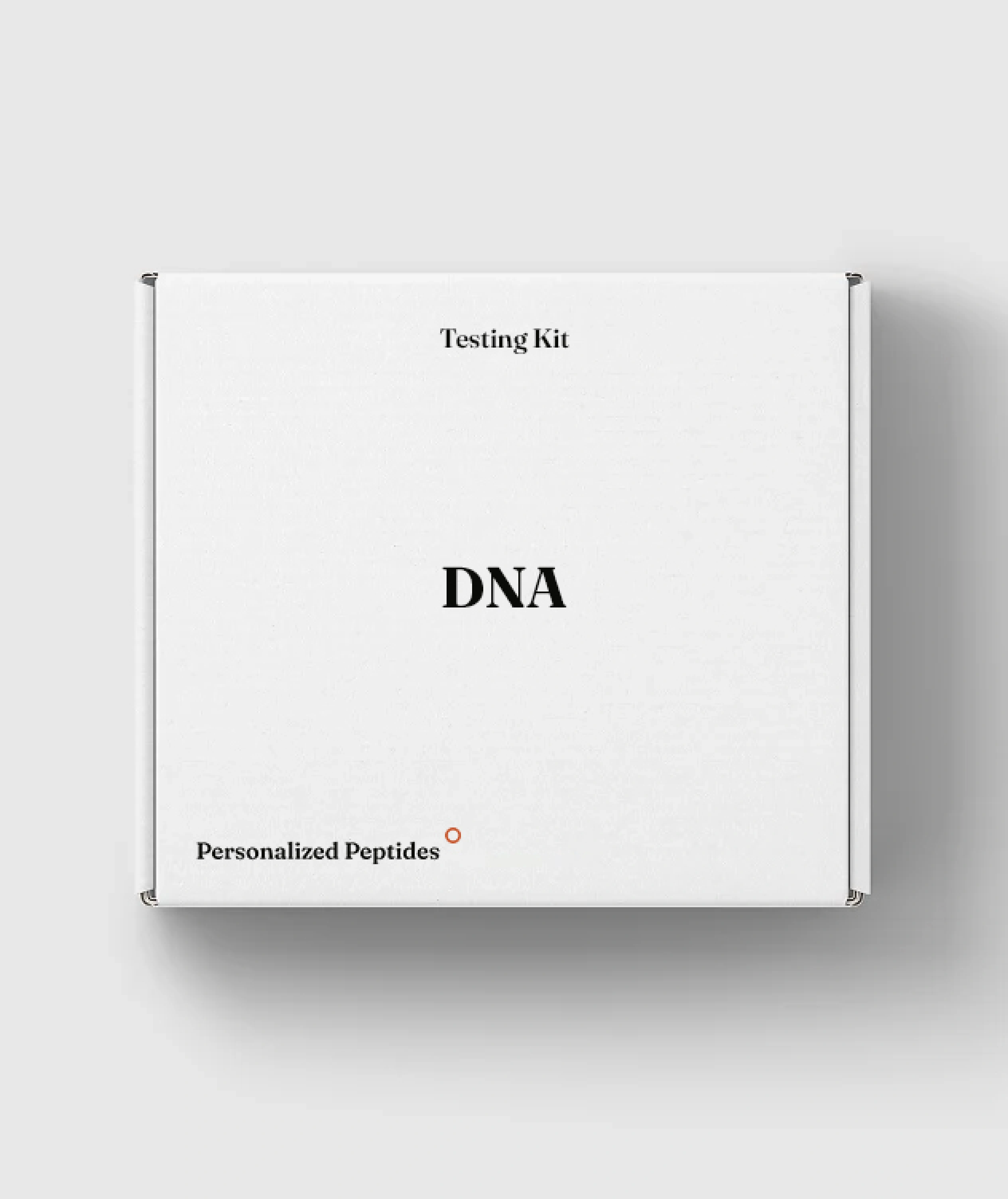
The DNA Foundation ($249) sequences 715,000+ genetic markers across 23 health domains and writes a personalized peptide protocol from your results. DNA is fixed at birth, so you only sequence it once.
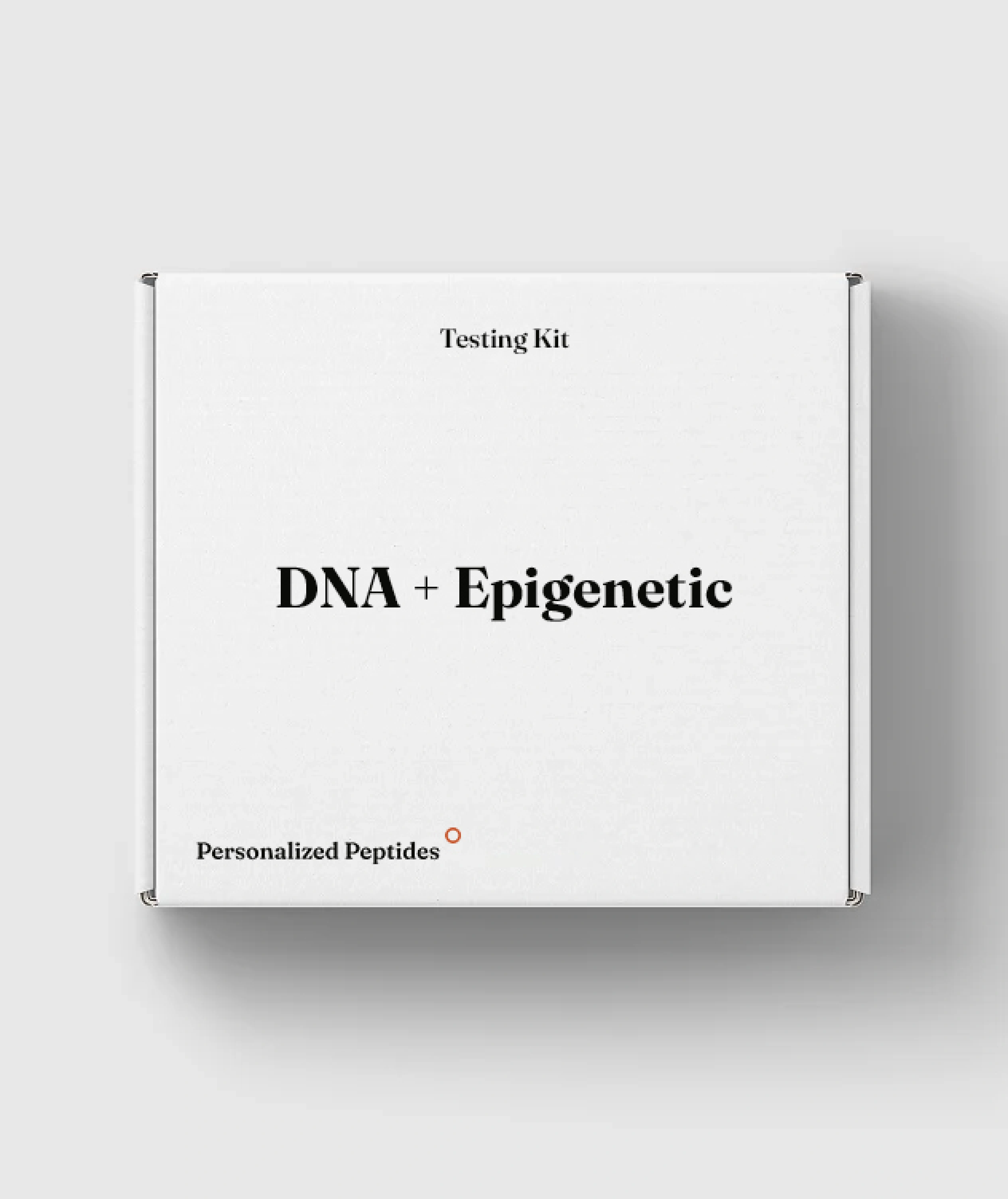
The DNA + Biological Age test ($499) includes everything in the Foundation, plus an epigenetic layer. Epigenetics measures how fast your cells are actually aging right now, separate from your genetic blueprint. Two scores: a biological age and a heart age, both retestable every six months to track whether your protocol is working.
DNA is your genetic blueprint. It is fixed at conception and never changes. Epigenetics is the layer on top: how your lifestyle, environment, and interventions are expressing or silencing those genes. Your DNA tells us your inherited risks and tendencies. Your epigenetic scores tell us what is actually happening in your body right now. They measure different things, which is why the combined test gives a more complete picture.
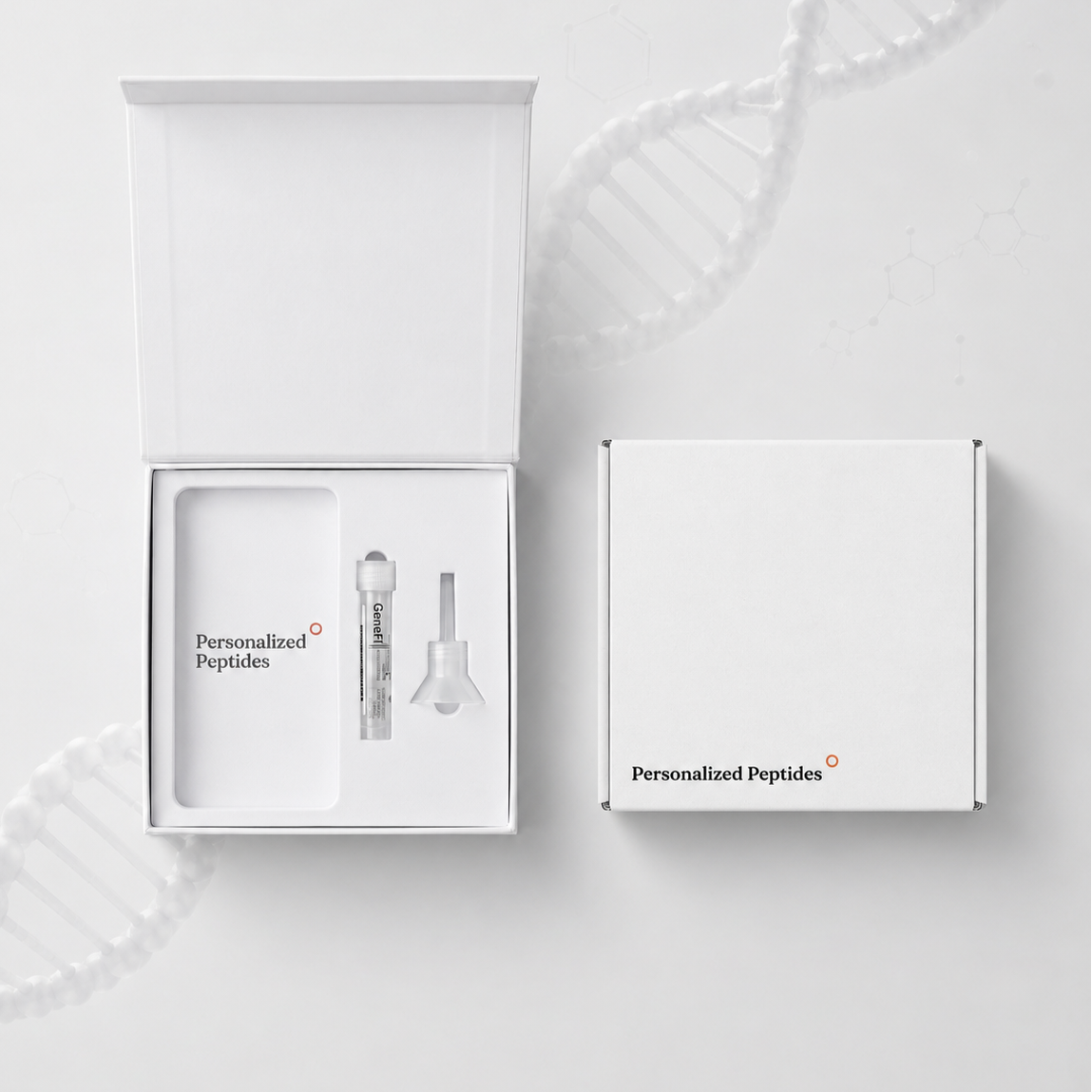
A saliva collection tube ships to your door within one to two business days. You provide a saliva sample, seal the tamper-evident tube, and return it using the prepaid envelope included. No refrigeration needed. Results are delivered to your dashboard in two to three weeks from the day the lab receives your sample.
A personalized peptide protocol is written from your results, matched to your specific genetic risks, goals, and biological age baseline. Your concierge walks you through the protocol, connects you with vetted suppliers or clinicians depending on what your results call for, and reviews your stack quarterly as your goals evolve.
No. These are wellness tests for optimizing health based on your biology. They do not diagnose, treat, or screen for medical conditions. If your results suggest something worth discussing with a clinician, your concierge will flag it and help you take the right next step.
No. You can order either test directly. The quiz is free and gives you a starting protocol based on your goals and lifestyle. The DNA tests go deeper and confirm which peptides your specific biology will respond to. Many people take the quiz first to understand the platform, then order a test when they want more precision. Either order works.
DNA does not change, so you only sequence it once. The epigenetic layer is different: biological age and heart age scores shift as your lifestyle and protocol change. Retesting every six months gives you a measurable before-and-after view of whether your stack is working.
No. Both tests are one-time purchases. Lifetime dashboard access and concierge support are included at no extra cost. If you already have the DNA Foundation, you can add the epigenetic layer from your dashboard at any time without repeating the DNA analysis.
Your blueprint is already written. Start reading it.
One saliva sample. A protocol matched to your biology. A number that proves it’s working.