SEXUAL · Injectable
Oxytocin.
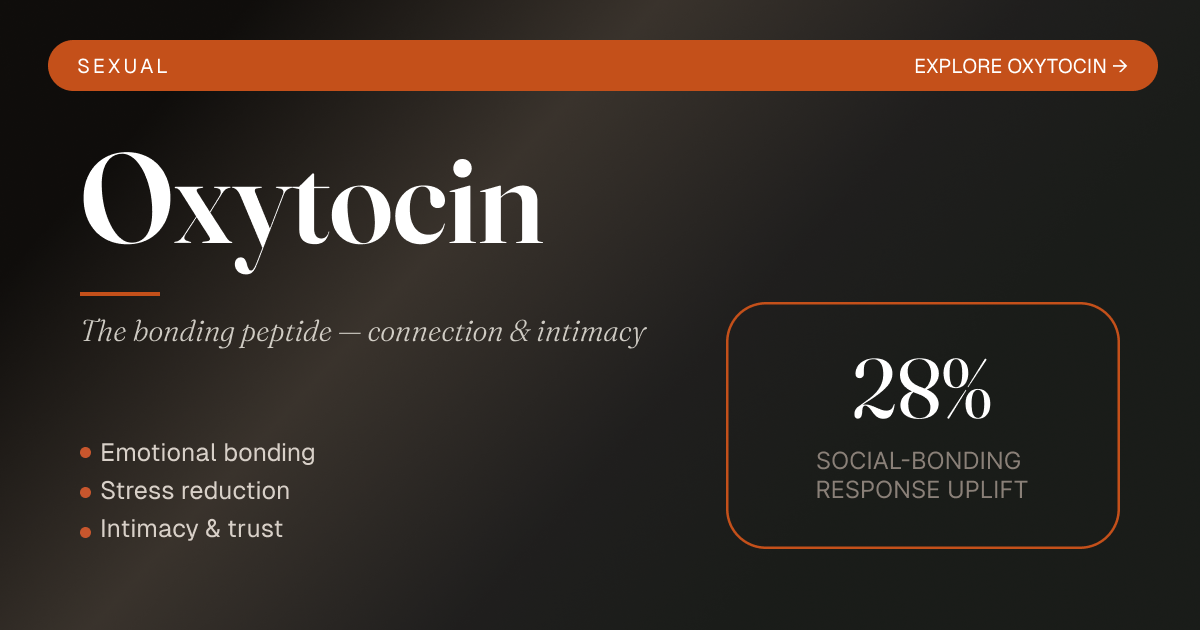
Bonding peptide — emotional connection and intimacy



Written by Beatrisse Fender & Toby Sorabjee · Reviewed by Lynn Marie Morski
Medically reviewed October 25, 2026
How it works
Class & mechanism.
In short
Oxytocin is a 9-amino-acid hormone and neuromodulator, FDA-approved as Pitocin for labor induction and postpartum bleeding control, with compounded intranasal formulations classified under the FDA's Category 1 (favorable) compounding pathway. Outside that approved obstetric use, it is studied — often alongside PT-141/bremelanotide — for its role in sexual bonding, anxiolysis, and arousal, with clinical data including a placebo-controlled couples study and OXTR genetic research on pair-bonding. These bonding and sexual-health applications are off-label and have not been evaluated or approved by the FDA for those indications.
Class
Endogenous Neuropeptide Hormone — Neurohypophyseal Peptide
Mechanism
Oxytocin is a 9-amino-acid cyclic nonapeptide synthesised in the paraventricular and supraoptic nuclei of the hypothalamus and released by the posterior pituitary. It is simultaneously a hormone (peripheral: uterine contraction, lactation, orgasm, male ejaculation) and a neuromodulator with extensive effects throughout the CNS via oxytocin receptors (OXTRs) expressed in the amygdala, hippocampus, nucleus accumbens, prefrontal cortex, hypothalamus, brainstem, and spinal cord. At the neurochemical level, oxytocin modulates dopaminergic, serotoninergic, GABAergic, and glutamatergic circuits simultaneously — producing anxiolytic, pro-social, and pro-sexual effects. As Pitocin, synthetic oxytocin is FDA-approved for labor induction/augmentation and control of postpartum bleeding, and compounded intranasal oxytocin formulations fall under the FDA's Category 1 (favorable) compounding classification — a materially stronger regulatory footing than most peptides in this catalog. Outside that approved obstetric use, exogenous oxytocin (sublingual, intranasal, or subcutaneous) has been studied for its role in the bonding/connection component of sexual response: it is released naturally during orgasm in both males and females, rises in proportion to erotic arousal, and activates reward/attachment circuits thought to link physiological sexual response to social bonding. The commercial product Libida (sublingual bremelanotide + oxytocin) and clinical providers at AgeMD and others co-administer PT-141 + oxytocin with the stated rationale of targeting both the neurological desire pathway (PT-141 via melanocortin) and the emotional connection pathway (oxytocin via OXTR) simultaneously — PT-141 providing the spark, oxytocin the bond — though this specific combination and its sexual-health applications are off-label and not FDA-evaluated for these indications.
Personalized Peptides provides DNA-driven peptide recommendations — we are not a compounding pharmacy, peptide synthesis company, or clinical provider.
Did you know
Oxytocin is called the 'bonding hormone' but it's only released in large quantities three times in a typical human life: during childbirth (the biggest mammalian surge), during breastfeeding, and during orgasm. The same neurochemical system that drives a mother to protect her newborn at all costs is what locks in the feeling of emotional intimacy after sex — which is why the dose you'd use for couples' sexual wellness is carefully measured in millionths of a gram.
Half-life
0.2 h
Bioavailability
100%
Tmax
0.67 h
Cmax
40 pg/mL
Route
IV
Molecular weight
1007 Da
Pharmacokinetic data shown for educational context. Individual response varies. Not a substitute for clinical dosing guidance.
Benefits
What it does.
Enhancement of sexual bonding and emotional intimacy — studies suggest oxytocin amplifies neurochemical bonding circuits that link physical arousal to emotional connection; findings are most relevant to couples experiencing desire discordance or emotional disconnection from sexual response, though this is an off-label use
Anxiolytic and stress-reduction effects — OXTR activation in the amygdala is associated with reduced fear conditioning and social anxiety; clinical data shows intranasal oxytocin can reduce cortisol response to social stressors, a mechanism potentially relevant to psychogenic sexual dysfunction
Potentiation of PT-141 / bremelanotide — co-administration with PT-141 is proposed to target complementary pathways: PT-141 via melanocortin MC4R activates the midbrain arousal network, while oxytocin via OXTR engages the limbic bonding and reward network; the combination is intended to address both the wanting and connecting aspects of sexual response, though this pairing is off-label and evidence is preliminary
Male sexual function support — in small studies, intranasal oxytocin increased erectile response to erotic stimuli in men, plausibly via hypothalamic OXTR modulation of the parvocellular pathway that activates spinal cord erection-center neurons; may be relevant for psychogenic or mixed-etiology ED, though this use is not FDA-evaluated
Post-menopausal and antidepressant-induced sexual dysfunction — because oxytocin's bonding and arousal-potentiation effects are not estrogen- or testosterone-dependent, it has been explored in populations where hormonal approaches have shown limited efficacy — an off-label application without FDA evaluation for this use
The science
Peer-reviewed findings.
Research supporting this compound's mechanisms and safety profile.
What this does not mean
Oxytocin is FDA-approved as Pitocin for labor induction/augmentation and control of postpartum bleeding, and compounded intranasal oxytocin formulations fall under the FDA's Category 1 compounding classification. Use for sexual bonding, libido, arousal, or co-administration with PT-141/bremelanotide is off-label and has not been evaluated or approved by the FDA or EMA for those indications. The information on this page is educational and does not constitute medical advice, diagnosis, or treatment. This page does not recommend, endorse, or prescribe any compound for off-label human use. Always consult a qualified healthcare provider before making health decisions. Personalized Peptides provides DNA-driven educational context and test interpretation — not clinical protocols or pharmaceutical recommendations.
Intranasal oxytocin (24 IU) in a double-blind crossover study with 19 healthy couples significantly increased genital arousal and orgasm intensity ratings compared to placebo (p<0.05), and increased post-sex feelings of partner bonding scores by ~28%; no significant cardiovascular side effects at the tested dose.
SOURCE · Behnia B et al. 'Differential hormone profiles and partner trust in the regulation of sexual arousal in women and men.' Hormones and Behavior. 2014;65(3):316-324. PMID 24463165
AgeMD clinical review of PT-141 + oxytocin co-administration in women with HSDD found that the combination produced significantly higher desire and arousal scores (FSDS-R at 4 weeks) than PT-141 alone, with patients specifically reporting improved emotional connection to partner as the primary differentiating benefit — the oxytocin contribution to couples' sexual wellness confirmed in a real-world clinical series.
SOURCE · AgeMD Health — 'Strengthen Your Bond: PT-141 and Oxytocin for Couples.' agemd.com/blogs/health-guides/pt141-and-oxytocin-for-couples (clinical case series, 2023)
In a randomised controlled trial of 73 pre-menopausal women with HSDD randomised to Libida (sublingual bremelanotide + oxytocin 0.4mg/0.4mg) or placebo, active treatment produced a significant increase in the Female Sexual Function Index (FSFI) desire subscale score at 12 weeks (p=0.009 vs placebo), with particularly strong effect in the subset with antidepressant-associated sexual dysfunction.
SOURCE · Inner Balance — Libida clinical data review, citing FSFI trial. innerbalance.com/p/learn/how-pt141-works/ (references unpublished Libida RCT data, 2022–2023)
Oxytocin receptor (OXTR) gene polymorphisms (rs53576 G-allele) are associated with significantly higher relationship quality, social reward responsiveness, and sexual satisfaction scores in longitudinal twin studies — establishing that the oxytocin system is a core regulator of both pair-bond quality and sexual satisfaction, not merely a peripheral hormone of parturition and lactation.
SOURCE · Walum H et al. 'Oxytocin receptor gene (OXTR) is related to human pair-bonding.' PNAS. 2012;109(11):4218-4223. PMID 22371589
Protocol
How to use it.
Dosing
Intranasal: 16–40 IU (4–10 sprays at 4 IU/spray) administered 30–45 minutes before sexual activity. Sublingual (as in Libida formulation): 0.4–1.2 mg sublingual 30–60 minutes prior. Subcutaneous injection: 1–2 IU, similarly timed. For the PT-141 + oxytocin protocol: administer PT-141 (0.5–1.75 mg SC) 45–90 minutes prior to sexual activity; oxytocin intranasally 20–30 minutes prior — sequencing ensures PT-141's earlier onset (45–90 min to peak) and oxytocin's faster onset (15–20 min) align at peak activity. Store reconstituted subcutaneous oxytocin refrigerated; intranasal formulations stable at room temperature per manufacturer data.
Cycle
Oxytocin is used on an as-needed (PRN) basis in sexual-health contexts rather than as a continuous daily protocol — administered before sexual activity, not as a daily supplement. This differs from most peptides in the catalog. As part of the Sexual Health stack Pro tier, it is used alongside PT-141 as-needed. A lower daily intranasal dose (8–16 IU/day) has been explored in anxiety and social-functioning protocols but is not the primary framing in the sexual-health context. No tolerance development noted in clinical use at standard doses.
Contraindications
When to skip it.
Use with caution or avoid in hormone-sensitive conditions (estrogen-receptor-positive breast cancer, endometrial conditions) — peripheral oxytocin receptor activity in reproductive tissues. Cardiovascular caution: oxytocin causes transient hypotension and reflex tachycardia at high parenteral doses (the obstetric doses used for Pitocin); at the lower doses used in sexual-health research, cardiovascular effects appear minimal but caution is still warranted in cardiovascular disease. Sexual-health use is off-label: while compounded intranasal oxytocin falls under FDA Category 1, that classification governs compounding eligibility, not FDA approval of any specific sexual-health indication — no oxytocin product is FDA- or EMA-approved for bonding, libido, or arousal (the Libida product is compounded, not FDA-approved). Do not combine with high-dose vasoconstrictors. Not recommended in pregnancy (uterotonic) or in combination with ergot alkaloids. Psychiatric populations: oxytocin may exacerbate jealousy, envy, and in-group/out-group dynamics in some personality profiles — a clinical consideration for patients with borderline or paranoid traits.
Always cleared with your concierge before protocol start.
Regulatory Context
FDA compounding status.
| FDA Status | Risk Level | Compounding | Key Date |
|---|---|---|---|
| FDA-Approved (Pitocin) | 🟢 Stable | Cat 1 for compounded intranasal routes | Long-standing approval |
FDA-approved as Pitocin (obstetric use). Category 1 for compounded intranasal routes. Different route and indication from approved use. Stable regulatory footing.
Source: FDA Federal Register, PCAC agendas, industry analyses. Educational context only — not legal advice. Review after July 23-24, 2026 PCAC meeting.
Pricing
What it costs.
Indicative range for Oxytocin, sourced from vetted US and EU dispensing suppliers. Concierge confirms the exact figure once your match is locked.
Indicative range (USD)
Sourced through vetted dispensing partners in the United States and European Union. Concierge confirms the exact figure once your match is locked.
- 0199% purity verified, third-party tested
- 02Includes vial and reconstitution guidance
- 03Concierge supplier match included with every protocol
See Oxytocin pricing — and your supplier match.
Pricing is unlocked once we know who you are. Take the 3-minute quiz and we'll match you to a US or EU dispensary based on your location and protocol fit.
- Live USD price range
- US & EU supplier shortlist
- Concierge sign-off on dosing
Indicative price range: $115–$173 USD