METABOLIC · Injectable
NAD+ 300.
Cellular energy and longevity coenzyme



Written by Beatrisse Fender & Toby Sorabjee · Reviewed by Lynn Marie Morski
Medically reviewed October 25, 2026
How it works
Class & mechanism.
In short
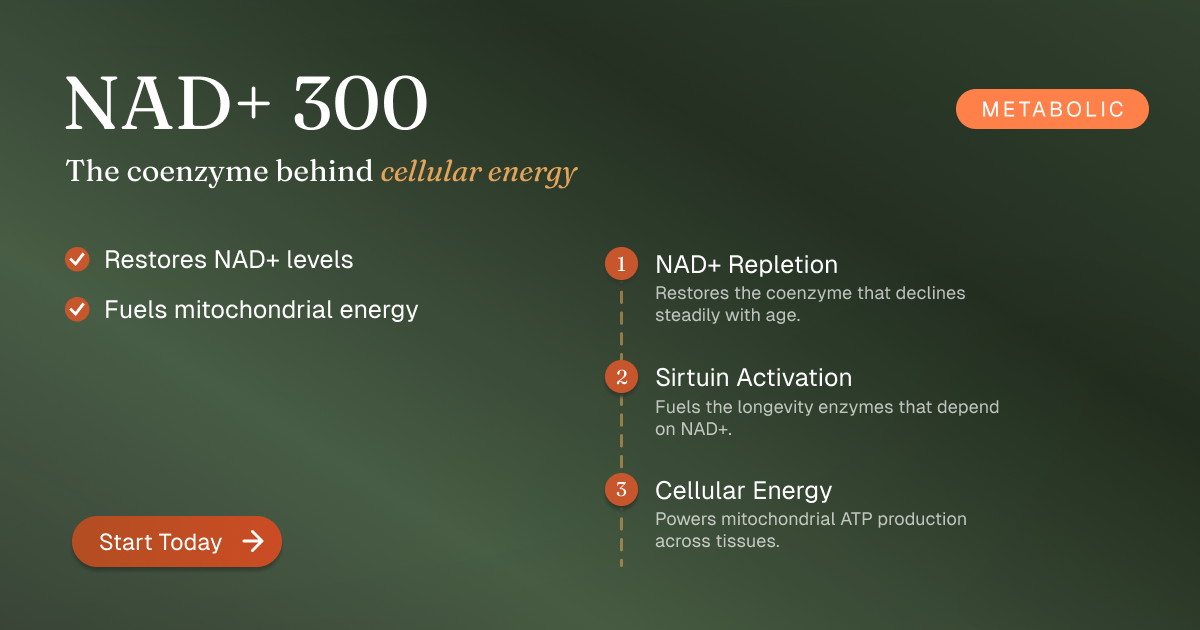
NAD+ is a coenzyme found in every cell — not a peptide — essential for energy production and for activating longevity-linked sirtuin enzymes. Levels decline over 50% with aging, and direct 300 mg injection (IV or SC) is studied as a way to rapidly restore systemic NAD+ availability. IV pharmacokinetics are well characterized, though clinical trial data on direct NAD+ injection is still emerging.
Class
NAD+ Coenzyme Therapy (300 mg Injection)
Mechanism
Nicotinamide adenine dinucleotide (NAD+) is a universal coenzyme found in every cell, essential for two distinct biological roles: as an electron carrier in redox reactions driving mitochondrial ATP production (converting carbohydrates, fats, and proteins into cellular energy), and as a substrate consumed by NAD+-dependent regulatory enzymes. Chief among these are the seven sirtuins (SIRT1–SIRT7) — deacetylase enzymes that use NAD+ to remove acetyl groups from histones and target proteins, regulating metabolic gene expression, mitochondrial biogenesis, fatty acid oxidation, circadian rhythm, and DNA repair. NAD+ levels decline 50%+ with aging and obesity, quenching sirtuin activity; direct NAD+ administration at 300 mg (subcutaneous or IV) bypasses intestinal and hepatic metabolism to rapidly restore systemic NAD+ availability, which preclinical and pharmacokinetic evidence indicates may help reactivate these longevity and metabolic pathways.
Personalized Peptides provides DNA-driven peptide recommendations — we are not a compounding pharmacy, peptide synthesis company, or clinical provider.
Did you know
NAD+ operates on the body's master metabolic clock — it's synthesized in a circadian oscillatory pattern by NAMPT, and its daily rise and fall is what tells sirtuins when to activate fat oxidation and DNA repair. When NAD+ levels collapse with age or obesity, it's not just energy that drops — the entire circadian metabolic program breaks down, which is why restoring NAD+ affects sleep, weight, cognition, and aging simultaneously.
Note · IV PK well-established — intracellular kinetics more complex
Half-life
0.125 h
Bioavailability
100%
Tmax
4 h
Cmax
50 µg/mL
Route
IV infusion
Molecular weight
663 Da
Pharmacokinetic data shown for educational context. Individual response varies. Not a substitute for clinical dosing guidance.
Preclinical Data
No human PK studies available.
Well-characterized biochemistry — limited SC/IM PK data. Not a peptide.
Class
Coenzyme / redox cofactor (not a peptide)
Route
IV / SC / Intranasal / Oral
Mol. Weight
663.4 Da
What we don't know
IV infusion PK is well-established from clinical detox/neurology protocols (t½ ~5-10 min in plasma due to rapid cellular uptake). SC pharmacokinetics are poorly characterized — injection-site metabolism by CD38/ectonucleotidases may significantly reduce bioavailability. Oral NAD+ has near-zero bioavailability; oral precursors (NR, NMN) are used instead. No formal SC PK study found.
Why this dosing protocol
Clinical IV protocols: 250-1000mg infused over 2-8 hours (detox/neurology). SC protocols are empirical: 100-500mg 2-3×/week, based on tissue depot effect rather than sustained plasma levels. Intranasal spray (RBT catalogue) may target CNS NAD+ pools directly. Oral precursors (NMN 250-500mg/day, NR 300mg/day) have better human PK data for raising intracellular NAD+ levels than any injectable route.
Empirical protocol: 100-500mg SC 2-3×/week; 250-1000mg IV infusion
Safety notes
- Not a peptide — coenzyme
- SC PK poorly characterized
- Oral precursors (NR/NMN) better studied
Pharmacokinetic data shown for educational context. All parameters are inferred or empirically derived — no formal human PK studies exist for this compound. Individual response varies. Not a substitute for clinical dosing guidance.
Benefits
What it does.
Restores declining NAD+ levels that drop 50%+ with aging, reactivating sirtuin longevity pathways
Enhanced mitochondrial function and ATP production — may improve cellular energy output
Activation of SIRT1 and SIRT3 may promote fat oxidation, reduce lipid accumulation, and improve insulin sensitivity
Supports DNA repair via PARP enzymes that require NAD+ — may reduce accumulation of DNA damage associated with aging
Improved metabolic flexibility: higher NAD+ levels shift cells toward fat oxidation over fat storage
Cognitive clarity, reduced fatigue, and improved physical endurance reported in clinical and real-world settings
The science
Peer-reviewed findings.
Research supporting this compound's mechanisms and safety profile.
What this does not mean
NAD+ is a coenzyme — not a peptide — and is not subject to FDA peptide compounding categories. The information on this page is educational and does not constitute medical advice, diagnosis, or treatment. NAD+ injection is not FDA-approved for anti-aging, metabolic, cognitive, or any other use, and direct-injection clinical trial data is still emerging. This page does not recommend, endorse, or prescribe any compound for human use. Always consult a qualified healthcare provider before making health decisions. Personalized Peptides provides DNA-driven educational context and test interpretation — not clinical protocols or pharmaceutical recommendations.
Systematic review and meta-analysis (PMC 2023): NAD+ precursor supplementation via nicotinic acid and nicotinamide modulates adipokines (leptin, adiponectin) and metabolic parameters associated with obesity; NAD+-dependent sirtuin activation regulates oxidative metabolism and has emerged as a treatment strategy for obesity
SOURCE · PMC10579603, Systematic Review & Meta-Analysis, 2023
2023 pharmacokinetic study: IV NAD+ administration produced peak plasma NAD+ levels roughly 6× higher than matched oral dosing, with tissue uptake detectable in muscle biopsies within hours — confirming the clinical rationale for parenteral delivery
SOURCE · Pharmacokinetic Study, 2023 (cited in Healthspan Research)
Yoshino et al. (Nature Medicine): NAMPT-mediated NAD+ biosynthesis in adipose tissue declines with high-fat diet and aging; restoring adipose NAD+ levels via supplementation reverses high-fat diet-induced metabolic dysfunction including glucose intolerance and insulin resistance in mouse models
SOURCE · Nature Medicine, Yoshino et al.
NAD+ levels decline in circadian oscillatory fashion via NAMPT (the rate-limiting enzyme for NAD+ biosynthesis); disruption of this circadian NAD+ cycling — caused by aging, high-fat diet, and poor sleep — degrades mitochondrial fatty acid oxidation and metabolic regulation throughout the day
SOURCE · PMC4112140, NAD+ and Sirtuins in Aging and Disease, Cell Metabolism 2014
Protocol
How to use it.
Dosing
300 mg NAD+ subcutaneous or intramuscular injection. Standard clinical protocols: SC/IM 100–300 mg injection, 2–3× per week. IV protocol: 250–500 mg in 500 mL saline over 2–4 hours, weekly. Loading phase: daily or every-other-day injections for 5–10 days at 100–250 mg/day, then taper to maintenance (100 mg SC, 2–3×/week). At-home SC injections typically 50–100 mg per dose, daily or several times weekly. IV sessions deliver near-100% bioavailability vs ~10–30% for oral forms.
Cycle
Loading phase of 3–4 weeks followed by maintenance schedule of 1–2× per month IV or weekly SC injections. Anti-aging and metabolic optimization protocols: 100 mg SC 2–3×/week ongoing. Synergistic with exercise — timing within 24 hours of high-intensity training may capitalize on exercise-induced NAMPT upregulation. Can be combined with NAD+ precursors (NMN, NR) for sustained between-session support. Long-term continuous use is well-tolerated; adjust frequency based on biomarker monitoring.
Contraindications
When to skip it.
Generally well-tolerated. IV infusions may cause flushing, nausea, headache, or chest tightness if administered too rapidly — must be infused slowly (2–4 hours). High-dose IV (>500 mg) should be conducted under medical supervision. Theoretical caution with medications affecting NAD+ metabolism. No major contraindications identified in clinical or research settings at standard doses. Avoid combining with PDE5 inhibitors without medical guidance. Safety data strongest for precursor forms (NR, NMN); direct NAD+ injection clinical trial data is still emerging.
Always cleared with your concierge before protocol start.
Regulatory Context
FDA compounding status.
| FDA Status | Risk Level | Compounding | Key Date |
|---|---|---|---|
| Category 1 Under Evaluation | 🟢 Stable | 503A eligible | Stable — no pending regulatory action |
NAD+ (nicotinamide adenine dinucleotide). Category 1 under evaluation. Widely compounded. Not a peptide — coenzyme involved in cellular energy metabolism. Stable regulatory footing. No pending PCAC review or enforcement action.
Source: FDA Federal Register, PCAC agendas, industry analyses. Educational context only — not legal advice. Review after July 23-24, 2026 PCAC meeting.
Pricing
What it costs.
Indicative range for NAD+ 300, sourced from vetted US and EU dispensing suppliers. Concierge confirms the exact figure once your match is locked.
Indicative range (USD)
Sourced through vetted dispensing partners in the United States and European Union. Concierge confirms the exact figure once your match is locked.
- 0199% purity verified, third-party tested
- 02Includes vial and reconstitution guidance
- 03Concierge supplier match included with every protocol
See NAD+ 300 pricing — and your supplier match.
Pricing is unlocked once we know who you are. Take the 3-minute quiz and we'll match you to a US or EU dispensary based on your location and protocol fit.
- Live USD price range
- US & EU supplier shortlist
- Concierge sign-off on dosing
Indicative price range: $99–$149 USD