LONGEVITY · Injectable
MOTS-c.
Mitochondria-derived metabolic regulator



Written by Beatrisse Fender & Toby Sorabjee · Reviewed by Lynn Marie Morski
Medically reviewed October 25, 2026
How it works
Class & mechanism.
In short
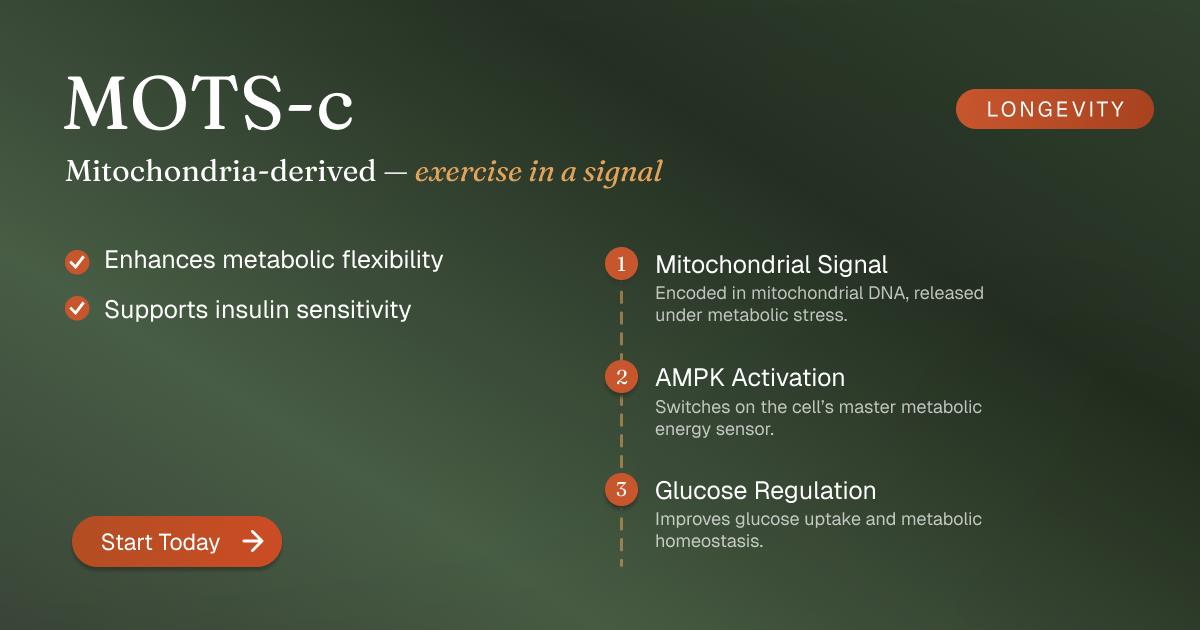
MOTS-c is a small peptide naturally produced inside mitochondria that acts as a signal to the rest of the cell during exercise or metabolic stress. Its main mechanism is activating AMPK, the body's central energy-sensing switch, which drives glucose uptake, fat burning, and mitochondrial upkeep. It's mainly studied as an exercise-mimetic for metabolic health, insulin sensitivity, and healthy aging.
Class
Mitochondrial-Derived Peptide (MDP)
Mechanism
MOTS-c (Mitochondrial Open Reading Frame of the 12S rRNA Type-c) is a 16-amino acid peptide encoded by a short open reading frame within mitochondrial 12S rRNA — the second known peptide encoded entirely within mitochondrial DNA. Under metabolic stress or exercise, MOTS-c translocates from the cytoplasm into the nucleus, where it acts as a retrograde mitochondrial-to-nuclear signal and directly regulates gene expression of stress-adaptation pathways containing antioxidant response elements (ARE). Its primary metabolic mechanism operates via the Folate-AICAR-AMPK axis: MOTS-c inhibits de novo purine biosynthesis and the folate cycle, causing AICAR accumulation which phosphorylates and activates AMPK — the master metabolic switch that drives glucose uptake, fatty acid oxidation, mitochondrial biogenesis via PGC-1α, and SIRT1-mediated anti-inflammatory signaling.
Personalized Peptides provides DNA-driven peptide recommendations — we are not a compounding pharmacy, peptide synthesis company, or clinical provider.
Did you know
MOTS-c is banned in competitive sports by WADA — which means regulators already consider it performance-enhancing enough to prohibit. It's essentially a molecular signal your mitochondria normally send during intense exercise, now available as an injection.
Preclinical Data
No human PK studies available.
Rodent PK only — no human PK data. Mitochondrial-encoded peptide with unique biology.
Class
Mitochondrial-derived peptide (MDP) — 16-AA metabolic regulator
Route
SC / IP (rodent); SC (human wellness)
Mol. Weight
2,174.6 Da
What we don't know
All PK data is rodent: Lee et al. (2015) demonstrated IP administration of MOTS-c in mice produced detectable plasma levels within 15 min, with effects on insulin sensitivity persisting for 24-48h after a single dose. Tissue distribution studies show accumulation in muscle, liver, and adipose tissue. No human PK data exists — no formal t½, bioavailability, Vd, or clearance measurements in any species. The mitochondrial origin makes MOTS-c unique among peptide therapeutics — it may have different clearance mechanisms than nuclear-encoded peptides.
Why this dosing protocol
Rodent protocols: 0.5-15 mg/kg IP daily or every other day for 2-4 weeks, producing improved glucose tolerance, increased energy expenditure, and reduced weight gain on high-fat diet. Human wellness protocols (5-10mg SC 3×/week) are extrapolated allometrically from rodent data. The every-other-day or 3×/week frequency is based on the persistence of metabolic effects (24-48h) after a single dose in rodent studies — continuous daily dosing may not be required. Effects are insulin-sensitising, not catabolic — MOTS-c is not a weight-loss peptide but a metabolic normaliser.
Empirical protocol: 5-10mg SC 3×/week; rodent studies 0.5-15mg/kg IP
Safety notes
- No human PK data
- Mitochondrial-encoded — unusual biology
- All rodent data
Pharmacokinetic data shown for educational context. All parameters are inferred or empirically derived — no formal human PK studies exist for this compound. Individual response varies. Not a substitute for clinical dosing guidance.
Benefits
What it does.
Exercise-mimetic metabolic activation — MOTS-c levels spike 11.9-fold in skeletal muscle and 1.6-fold in plasma following acute exercise in healthy young men, with AMPK activation mimicking key biochemical adaptations of physical training
Insulin sensitivity and metabolic flexibility — improves glucose uptake independent of insulin, reduces markers of insulin resistance, and corrects metabolic dysfunction in type 2 diabetes and PCOS models via AMPK/PGC-1α axis
Muscle and bone preservation — skeletal muscle MOTS-c rejuvenates aging-related muscle phenotypes in mice; MOTS-c activates AMPK in osteoblasts to prevent ovariectomy-induced bone loss and supports bone metabolism
Anti-inflammatory and cardiovascular protection — activates Keap1/Nrf2 antioxidant pathway, reduces pro-inflammatory cytokines, restores cardiac mitochondrial respiration in diabetic heart models, and suppresses NF-kB-mediated inflammaging
The science
Peer-reviewed findings.
Research supporting this compound's mechanisms and safety profile.
What this does not mean
MOTS-c is a research chemical. The information on this page is educational and does not constitute medical advice, diagnosis, or treatment. MOTS-c is not FDA-approved for metabolic, insulin-sensitivity, muscle, bone, or anti-inflammatory use. This page does not recommend, endorse, or prescribe any compound for human use. Always consult a qualified healthcare provider before making health decisions. Personalized Peptides provides DNA-driven educational context and test interpretation — not clinical protocols or pharmaceutical recommendations.
MOTS-c serum concentration positively correlates with lower-body muscle strength parameters in young adults, and circulating MOTS-c levels are significantly reduced in type 2 diabetes, gestational diabetes, PCOS, obese children, and coronary endothelial dysfunction — establishing it as a metabolic health biomarker
SOURCE · Domin R et al., International Journal of Molecular Sciences 24(19):14951, 2023; Ramanjaneya et al., 2019; multiple studies reviewed in Kong BS et al., Diabetes & Metabolism Journal 47(3):315–324, 2023
In ovariectomized female mice (menopause model), MOTS-c 5 mg/kg i.p. for 5 weeks significantly reduced white adipose and liver fat accumulation, activated brown adipose tissue, and improved insulin sensitivity via AMPK activation — suggesting particular relevance for post-menopausal metabolic decline
SOURCE · Lu H et al., Journal of Molecular Medicine 97:473–85, 2019; reviewed in Alzheimer's Drug Discovery Foundation MOTS-c monograph, 2025
MOTS-c restores mitochondrial respiration and citrate synthase activity in the type 2 diabetic heart through AMPK-mediated mitochondrial biogenesis, partially replicating the cardiac benefits of exercise in a rat T2DM model
SOURCE · Frontiers in Physiology 2025, doi:10.3389/fphys.2025.1602271; Nature Scientific Reports 2023
MOTS-c prevents pancreatic islet cell senescence and delays onset of diabetes in an experimental model, with MOTS-c-treated islet cells showing reduced senescence markers and preserved beta-cell function
SOURCE · Kong BS et al., Experimental & Molecular Medicine 57(8):1861–1877, 2025
Protocol
How to use it.
Dosing
Preclinical longevity/metabolic protocols: 5–15 mg/kg subcutaneous or intraperitoneal injection in mice. Human off-label protocols: 5–10 mg subcutaneous injection 1–3 times per week. MOTS-c does not cross the blood-brain barrier systemically — intranasal or intracerebroventricular administration required for direct CNS effects. USADA has added MOTS-c to its prohibited list for competitive sports.
Cycle
No formally established human cycling protocol. Research-based off-label cycles typically run 4–8 weeks on, 2–4 weeks off. Because MOTS-c is naturally induced by exercise and stress, some practitioners use it in focused metabolic or weight-loss phases rather than year-round.
Contraindications
When to skip it.
Banned by the World Anti-Doping Agency (WADA) and US Anti-Doping Agency (USADA) — prohibited in competitive sports. Sex-dependent effects noted: males show greater disruption of MOTS-c signaling in metabolic disease; pre-menopausal females may have partial estrogen-mediated protection. Not BBB-penetrant via standard SC injection — systemic injection is unlikely to produce direct cognitive effects. No human clinical trial safety data available.
Always cleared with your concierge before protocol start.
Regulatory Context
FDA compounding status.
| FDA Status | Risk Level | Compounding | Key Date |
|---|---|---|---|
| PCAC Review July 2026 | 🔴 At Risk | Awaiting PCAC — 503A eligibility review | PCAC July 23, 2026 |
Removed from Category 2 (Apr 23, 2026). Under PCAC review July 23. Search volume up 511% YoY — fastest-growing peptide in the catalog. Gray zone until formal 503A listing.
Source: FDA Federal Register, PCAC agendas, industry analyses. Educational context only — not legal advice. Review after July 23-24, 2026 PCAC meeting.
Pricing
What it costs.
Indicative range for MOTS-c, sourced from vetted US and EU dispensing suppliers. Concierge confirms the exact figure once your match is locked.
Indicative range (USD)
Sourced through vetted dispensing partners in the United States and European Union. Concierge confirms the exact figure once your match is locked.
- 0199% purity verified, third-party tested
- 02Includes vial and reconstitution guidance
- 03Concierge supplier match included with every protocol
See MOTS-c pricing — and your supplier match.
Pricing is unlocked once we know who you are. Take the 3-minute quiz and we'll match you to a US or EU dispensary based on your location and protocol fit.
- Live USD price range
- US & EU supplier shortlist
- Concierge sign-off on dosing
Indicative price range: $120–$180 USD