GUT · Injectable
KPV.
α-MSH-derived tripeptide — anti-inflammatory mucosal repair



Written by Beatrisse Fender & Toby Sorabjee · Reviewed by Lynn Marie Morski
Medically reviewed October 24, 2026
How it works
Class & mechanism.
In short
KPV (Lys-Pro-Val) is the three-amino-acid C-terminal fragment of alpha-melanocyte stimulating hormone (α-MSH), studied for its ability to inhibit the NF-κB inflammatory pathway at mucosal surfaces without the HPA-axis suppression associated with steroids. It is researched primarily for gut-targeted anti-inflammatory applications, including inflammatory bowel disease models, often alongside BPC-157 as a complementary gut-repair pair. Evidence to date is preclinical (cell culture and animal colitis models), and KPV is currently under FDA Pharmacy Compounding Advisory Committee (PCAC) review, scheduled for July 23, 2026.
Class
Alpha-MSH C-Terminal Tripeptide — Mucosal Anti-Inflammatory Peptide
Mechanism
KPV (Lys-Pro-Val) is the C-terminal tripeptide sequence of alpha-melanocyte stimulating hormone (α-MSH), a 13-amino-acid neuropeptide derived from POMC (proopiomelanocortin). While full-length α-MSH acts primarily on melanocortin receptors (MC1R–MC5R) for pigmentation, temperature regulation, and appetite, KPV retains the anti-inflammatory potency of α-MSH in a minimal bioavailable unit that preferentially targets mucosal and epithelial tissues. KPV's primary mechanism is inhibition of the NF-κB (nuclear factor kappa-B) signaling pathway — the master inflammatory transcription factor that drives production of TNF-α, IL-1β, IL-6, IL-8, and downstream inflammatory cascades. Unlike corticosteroids, KPV achieves NF-κB inhibition without hypothalamic-pituitary-adrenal (HPA) axis suppression or the classic steroid side-effect profile. KPV also acts directly on intestinal epithelial cells and lamina propria macrophages to reduce cytokine-mediated barrier disruption — mechanistically complementary to BPC-157's angiogenic barrier repair, explaining why the two are the canonical gut-healing pair. KPV is orally bioavailable for mucosal-surface contact effect and also penetrates the intestinal epithelium systemically when administered as a nanoparticle formulation or via injection, enabling both local gut-surface and systemic anti-inflammatory effects.
Personalized Peptides provides DNA-driven peptide recommendations — we are not a compounding pharmacy, peptide synthesis company, or clinical provider.
Did you know
KPV is the three-amino-acid tail of α-MSH — the same hormone that controls skin tanning. Strip away 10 of α-MSH's 13 amino acids and what's left is a molecule that appears unable to tan skin at all, but in preclinical studies retains much of α-MSH's inflammation-suppressing activity in the gut — a structural quirk that has made it one of the more closely studied mucosal anti-inflammatory tripeptides.
Preclinical Data
No human PK studies available.
Research compound — no clinical PK data, mechanism inferred
Class
Synthetic tetrapeptide — α-MSH C-terminal fragment
Route
SC / Topical
Mol. Weight
500.6 Da
What we don't know
This is a research compound with no formal PK characterisation. As a small, stabilized tetrapeptide, absorption is expected to be rapid across SC/topical routes. Clearance likely renal + proteolytic. All PK parameters are unknown.
Why this dosing protocol
Dosing protocols are entirely empirical. Used in research contexts at 100-500mcg SC daily for anti-inflammatory applications. Often combined with BPC-157 for gut and systemic inflammation protocols. Acetylation and amidation of termini provide modest proteolytic protection.
Empirical protocol: 100-500mcg SC daily
Safety notes
- No clinical data
- Research compound only
Sources
Pharmacokinetic data shown for educational context. All parameters are inferred or empirically derived — no formal human PK studies exist for this compound. Individual response varies. Not a substitute for clinical dosing guidance.
Benefits
What it does.
Mucosal inflammation reduction — in cell-culture studies, KPV inhibits NF-κB in intestinal epithelial cells and macrophages and reduces TNF-α, IL-1β, IL-6 at the mucosal surface without HPA axis suppression or steroid side effects
Inflammatory bowel disease management — animal models of IBD (DSS-colitis, TNBS-colitis) show significant reductions in colon inflammation scores, mucosal damage indices, and inflammatory cytokine production with KPV administration, though this has not been confirmed in human trials
Gut barrier restoration — KPV is thought to complement BPC-157's angiogenic mechanism by reducing the inflammatory disruption that increases tight-junction permeability ('leaky gut'): repair of the physical barrier (BPC) + reduction of the inflammatory signal driving disruption (KPV)
Systemic anti-inflammatory effects — beyond gut mucosa, KPV may reduce systemic inflammatory markers; potential applications in skin inflammation, wound healing, and inflammatory arthritis in preclinical models
Oral bioavailability advantage — KPV's tripeptide size is reported to make it orally bioavailable for direct mucosal contact in the intestinal lumen, positioning oral/sublingual delivery as a preferred research route for gut-targeted applications
The science
Peer-reviewed findings.
Research supporting this compound's mechanisms and safety profile.
What this does not mean
KPV is a research chemical. The information on this page is educational and does not constitute medical advice, diagnosis, or treatment. KPV is not FDA-approved for treating inflammatory bowel disease, gut inflammation, or any other use. KPV was removed from FDA Category 2 (Apr 23, 2026) and is currently under Pharmacy Compounding Advisory Committee (PCAC) review, scheduled for July 23, 2026, to determine 503A Bulks List eligibility — even a favorable PCAC vote would require a further 12–24 month notice-and-comment rulemaking process before formal compounding authorization. KPV's regulatory status is currently in a gray zone: not prohibited, not authorized. This page does not recommend, endorse, or prescribe any compound for human use. Always consult a qualified healthcare provider before making health decisions. Personalized Peptides provides DNA-driven educational context and test interpretation — not clinical protocols or pharmaceutical recommendations.
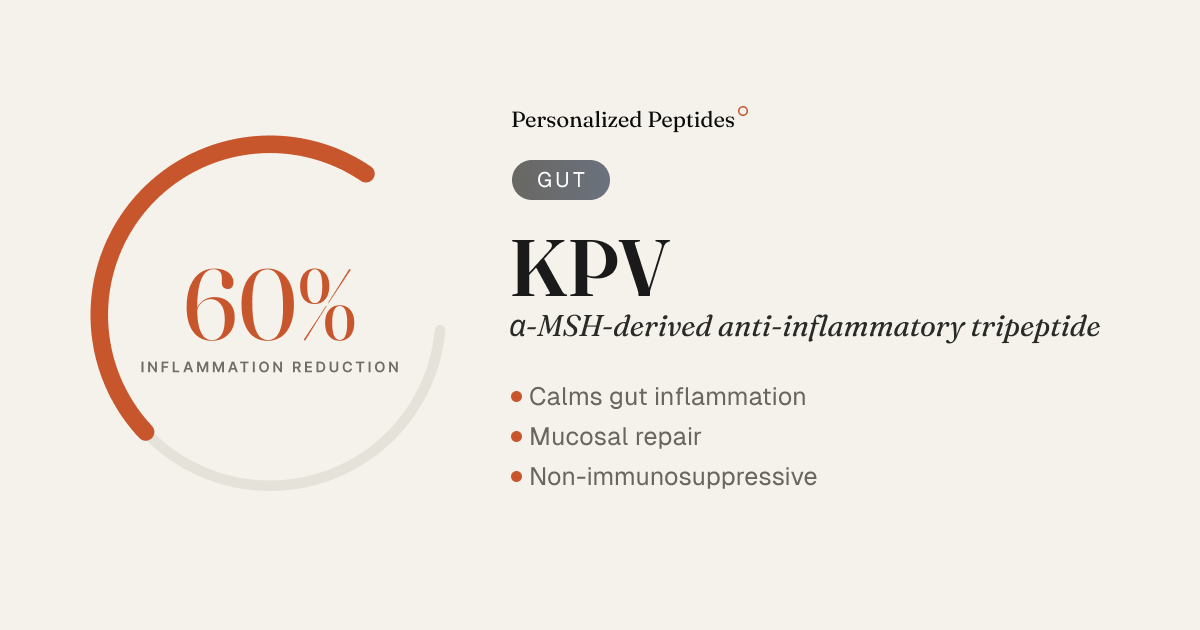
KPV administered via nanoparticle hydrogel formulation in a DSS-induced murine colitis model produced significant reduction in colonic inflammation — Disease Activity Index (DAI) scores were 60% lower versus vehicle controls, with histological evidence of preserved mucosal architecture and reduced CD3+ T-cell infiltration. Oral administration route was effective without systemic delivery.
SOURCE · Laroui H et al. 'Gastrointestinal delivery of anti-inflammatory nanoparticles.' J Vis Exp. 2011;(54):3067. PMID 21918522. PMC3231060
KPV directly inhibits NF-κB nuclear translocation in human colonic epithelial cells (HT-29 cell line) stimulated with TNF-α and IL-1β, reducing pro-inflammatory cytokine secretion (IL-6, IL-8) by 40–70% without affecting cell viability — confirming a non-toxic, epithelial-targeted anti-inflammatory mechanism distinct from steroid pathways.
SOURCE · Brzoska T et al. 'Alpha-melanocyte-stimulating hormone and related tripeptides: biochemistry, antiinflammatory and protective effects in vitro and in vivo, and future perspectives for the treatment of immune-mediated inflammatory diseases.' Endocrine Reviews. 2008;29(5):581-602. PMID 18612139
In a TNBS-induced rat colitis model, intracolonic KPV reduced macroscopic inflammation score by 55% and mucosal MPO (myeloperoxidase — a neutrophil-activity marker) activity by 48% relative to untreated controls, with colonic TNF-α and IL-1β mRNA significantly suppressed. The anti-inflammatory effect was comparable to dexamethasone in the same model without corticosteroid-associated thymus involution.
SOURCE · Dalmasso G et al. 'The Peptide KPV Mediates Anti-Inflammatory Effects by Blocking I-κB Kinase β (IKKβ)-Mediated NF-κB Signaling.' The American Journal of Pathology. 2008;173(2):338-349. PMID 18599598. PMC2475775
Protocol
How to use it.
Dosing
Research-based dosing: 500 mcg–2 mg per day for gut-targeted indications. Oral administration (capsule or sublingual) preferred for GI-localised effect — tripeptide size enables direct mucosal contact and some epithelial penetration. Injectable (subcutaneous) at 100–500 mcg/day for systemic anti-inflammatory applications. Oral nanoparticle formulations under active research produce enhanced mucosal delivery. Often co-administered with oral BPC-157 spray (500 mcg–1 mg/day) as the complementary lining-repair compound. Dose timing: typically divided into 2 doses (morning and evening) for continuous mucosal anti-inflammatory coverage.
Cycle
4–8 weeks for acute IBD flares or post-antibiotic gut recovery. Longer cycles of 8–12 weeks for chronic inflammatory gut patterns. Can be used as a continuous low-dose maintenance protocol (500 mcg/day oral) alongside BPC spray without significant tolerance issues in clinical practice. As the Standard tier anchor of the Gut & GI Repair stack, KPV is the direct anti-inflammatory complement to BPC-157's barrier-repair mechanism — the two compounds are intended to run concurrently.
Contraindications
When to skip it.
No human clinical trials have been completed as of 2025 — all efficacy data is preclinical (murine colitis models, cell culture). No regulatory approval for any indication. Alpha-MSH receptor cross-activity (MC1R, MC3R, MC4R) is possible at higher doses — MC4R activity could theoretically affect energy balance and appetite at systemic doses. Distinct from full α-MSH's melanocortin side effects but tripeptide-level cross-reactivity profile is not fully characterized in humans. Use under physician supervision only. Not recommended in pregnancy or lactation. Patients with melanoma or other melanocyte-derived malignancies should exercise particular caution given α-MSH lineage.
Always cleared with your concierge before protocol start.
Regulatory Context
FDA compounding status.
| FDA Status | Risk Level | Compounding | Key Date |
|---|---|---|---|
| PCAC Review July 2026 | 🔴 At Risk | Awaiting PCAC — 503A eligibility review | PCAC July 23, 2026 |
α-MSH-derived tripeptide. Removed from Category 2 (Apr 23, 2026). Under PCAC review July 23 for 503A eligibility. Anti-inflammatory mucosal repair applications.
Source: FDA Federal Register, PCAC agendas, industry analyses. Educational context only — not legal advice. Review after July 23-24, 2026 PCAC meeting.
Pricing
What it costs.
Indicative range for KPV, sourced from vetted US and EU dispensing suppliers. Concierge confirms the exact figure once your match is locked.
Indicative range (USD)
Sourced through vetted dispensing partners in the United States and European Union. Concierge confirms the exact figure once your match is locked.
- 0199% purity verified, third-party tested
- 02Includes vial and reconstitution guidance
- 03Concierge supplier match included with every protocol
See KPV pricing — and your supplier match.
Pricing is unlocked once we know who you are. Take the 3-minute quiz and we'll match you to a US or EU dispensary based on your location and protocol fit.
- Live USD price range
- US & EU supplier shortlist
- Concierge sign-off on dosing
Indicative price range: $115–$173 USD