SEXUAL · Injectable
Kisspeptin.
Master HPG axis regulator — endogenous hormone restoration



Written by Beatrisse Fender & Toby Sorabjee · Reviewed by Lynn Marie Morski
Medically reviewed October 21, 2026
How it works
Class & mechanism.
In short
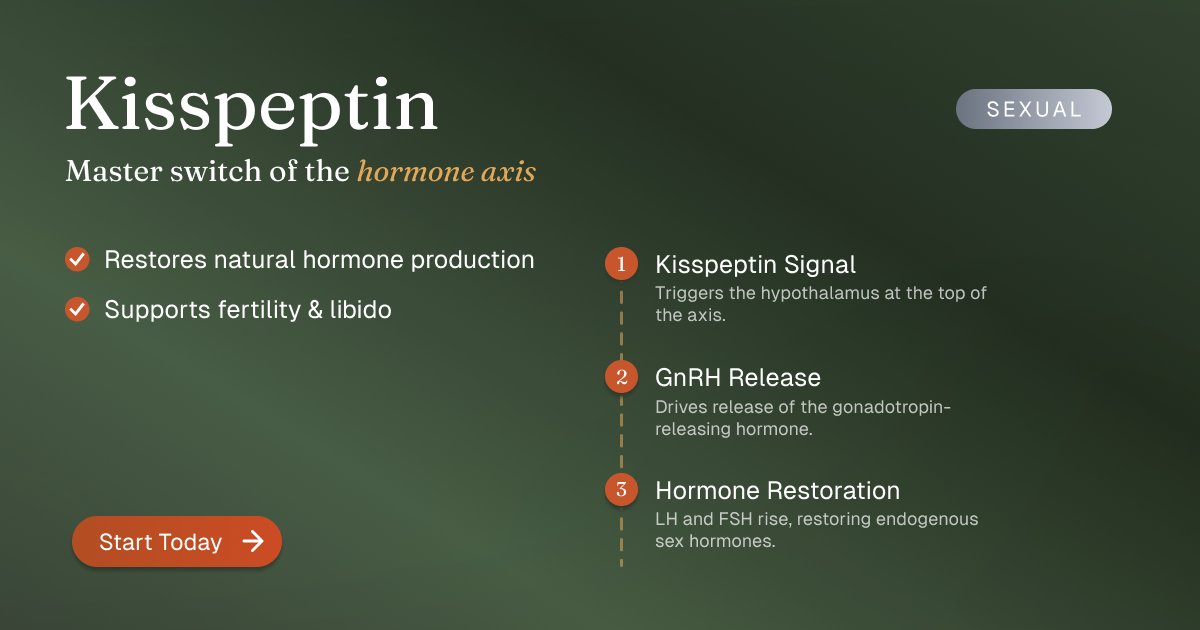
Kisspeptin is a 54-amino acid neuropeptide that sits at the very top of the reproductive hormone cascade, triggering the pulsatile GnRH release that in turn drives LH, FSH, and downstream testosterone and estrogen production. Clinical research has explored it for fertility, hypothalamic amenorrhea, and testosterone restoration, with data on effects on brain arousal circuitry and libido. Kisspeptin remains on the FDA's Category 2 do-not-compound list, so it is not currently available as a compounded or prescribed product and this content is provided for educational context only.
Class
Neuropeptide / Hormonal Regulator
Mechanism
Kisspeptin is a 54-amino acid neuropeptide encoded by the KISS1 gene that acts as the master upstream regulator of the hypothalamic-pituitary-gonadal (HPG) axis. It binds to the GPR54 receptor on GnRH neurons in the hypothalamus, triggering pulsatile release of gonadotropin-releasing hormone (GnRH), which in turn stimulates LH and FSH secretion from the pituitary. This positions kisspeptin as the highest-level controller of reproductive hormone signalling — above even GnRH itself in the regulatory hierarchy. Clinical trials have explored kisspeptin for infertility, hypothalamic amenorrhea, and as a potential alternative to hCG for testosterone restoration.
Personalized Peptides provides DNA-driven peptide recommendations — we are not a compounding pharmacy, peptide synthesis company, or clinical provider.
Did you know
Kisspeptin sits above every other reproductive hormone in your body's command chain — it tells your brain when to release GnRH, which tells your pituitary when to release LH and FSH, which tells your gonads when to produce testosterone and estrogen. There is no higher-level switch for your hormonal system.
Preclinical Data
No human PK studies available.
Human PK from reproductive endocrinology trials — IV t½ ~28 min, SC not formally characterized
Class
Endogenous KISS1 receptor ligand — HPG axis master regulator
Route
SC / IV
Mol. Weight
1,302.5 Da
What we don't know
Human PK established for IV administration (Dhillo et al. 2005, 2007): t½ ~27.6 ± 2.3 min, Vd ~12.6 L, clearance ~1.3 L/min, consistent across kisspeptin-54 and kisspeptin-10 fragments. SC PK is not formally characterized — bioavailability, Tmax, and Cmax for SC are inferred from pharmacodynamic effects (LH pulse timing) rather than direct measurement. Long-term safety data exists only for single-dose and 12-hour infusion protocols in reproductive endocrinology settings. No chronic-dosing human PK studies.
Why this dosing protocol
Clinical research protocols use IV bolus (1-6.4 nmol/kg) producing LH pulses within 30 min that persist 2-3 hours. SC dosing in wellness protocols (50-200mcg 1-2×/day) is based on pharmacodynamic inference: the LH response to SC is slower onset but more sustained than IV. For HPG axis restoration in hypogonadism, pulsatile administration (2-3×/day) better mimics physiological GnRH pulsing than single daily dosing. The peptide does not accumulate — short t½ means each dose is independent.
Empirical protocol: 1-6.4 nmol/kg IV bolus (research); 50-200mcg SC (wellness protocols)
Safety notes
- SC PK not formally characterized
- Limited chronic-dosing data
- Fertility implications — may affect ovulation/spermatogenesis
Pharmacokinetic data shown for educational context. All parameters are inferred or empirically derived — no formal human PK studies exist for this compound. Individual response varies. Not a substitute for clinical dosing guidance.
Benefits
What it does.
HPG axis support — in clinical studies, pulsatile administration stimulates natural testosterone and estrogen production via physiological GnRH release rather than exogenous hormone replacement
Fertility support — clinical trials report that kisspeptin can induce ovulation in anovulatory women by triggering a physiological LH surge
Libido and sexual function — kisspeptin administration is associated with increased brain activity in sexual arousal circuits; fMRI studies report enhanced activity in regions linked to romantic and sexual response
Testosterone support — clinical studies suggest it may stimulate endogenous testosterone production while avoiding the testicular atrophy risk associated with exogenous testosterone or hCG
The science
Peer-reviewed findings.
Research supporting this compound's mechanisms and safety profile.
What this does not mean
Kisspeptin remains on the FDA's Category 2 (do-not-compound) list. The information on this page is educational and does not constitute medical advice, diagnosis, or treatment, and does not indicate current availability, legality, or eligibility for compounding or clinical use. Kisspeptin is not FDA-approved for treating infertility, hypogonadism, sexual dysfunction, or any other condition. This page does not recommend, endorse, or prescribe any compound for human use. Always consult a qualified healthcare provider before making health decisions. Personalized Peptides provides DNA-driven educational context and test interpretation — not clinical protocols or pharmaceutical recommendations.
Kisspeptin administration in healthy men produces dose-dependent increases in LH, FSH, and testosterone — confirming its role as the master HPG axis regulator in humans
SOURCE · Dhillo WS et al., multiple clinical trials; Imperial College London kisspeptin research program
fMRI studies show kisspeptin administration enhances brain activity in limbic and paralimbic regions associated with sexual arousal and romantic love — suggesting direct CNS effects on libido and emotional bonding
SOURCE · Comninos AN et al., Journal of Clinical Investigation; Imperial College London neuroimaging studies
Protocol
How to use it.
Dosing
Clinical trial dosing: 0.1–1.0 nmol/kg IV bolus or subcutaneous injection; research protocols have also explored 100–300 mcg subcutaneous injection, 2–3× per week. These figures reflect clinical-trial and research dosing, not current compounding or prescribing guidance — kisspeptin remains on the FDA's Category 2 do-not-compound list and is not available as a compounded or prescribed product.
Cycle
Research protocols typically use acute or pulsatile administration. No established long-term cycling data. Intermittent dosing (2–3× weekly) is favored in the literature to help preserve receptor sensitivity, since continuous exposure can downregulate GPR54.
Contraindications
When to skip it.
Potential for HPG axis suppression with continuous (non-pulsatile) administration. Not suitable during pregnancy. Limited long-term safety data. Banned by WADA. Kisspeptin remains on the FDA's Category 2 do-not-compound list — it is not currently available as a compounded or prescribed product in the US.
Always cleared with your concierge before protocol start.
Regulatory Context
FDA compounding status.
| FDA Status | Risk Level | Compounding | Key Date |
|---|---|---|---|
| Category 2 — Do Not Compound | 🔴 At Risk | Not eligible — remains on Category 2 | No PCAC date announced |
Moved to Category 2 in late 2023 as Kisspeptin-10. NOT among the 12 peptides removed Apr 23, 2026. Not on either PCAC agenda. Remains prohibited for compounding. Master HPG axis regulator.
Source: FDA Federal Register, PCAC agendas, industry analyses. Educational context only — not legal advice. Review after July 23-24, 2026 PCAC meeting.
Pricing
What it costs.
Indicative range for Kisspeptin, sourced from vetted US and EU dispensing suppliers. Concierge confirms the exact figure once your match is locked.
Indicative range (USD)
Sourced through vetted dispensing partners in the United States and European Union. Concierge confirms the exact figure once your match is locked.
- 0199% purity verified, third-party tested
- 02Includes vial and reconstitution guidance
- 03Concierge supplier match included with every protocol
See Kisspeptin pricing — and your supplier match.
Pricing is unlocked once we know who you are. Take the 3-minute quiz and we'll match you to a US or EU dispensary based on your location and protocol fit.
- Live USD price range
- US & EU supplier shortlist
- Concierge sign-off on dosing
Indicative price range: $112–$168 USD