PERFORMANCE · Injectable
IGF-1 LR3.
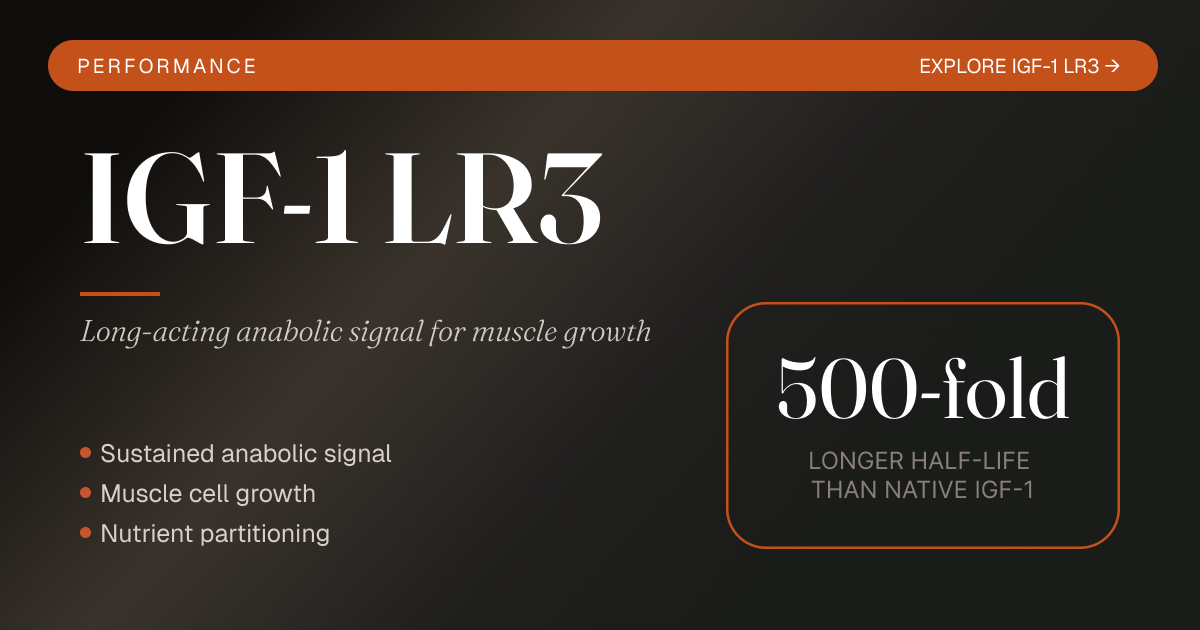
Long-acting anabolic signal for muscle growth



Written by Beatrisse Fender & Toby Sorabjee · Reviewed by Lynn Marie Morski
Medically reviewed October 25, 2026
How it works
Class & mechanism.
In short
IGF-1 LR3 is a lab-modified version of IGF-1, the growth signal muscles normally receive after growth hormone release. The modification makes it stay active in the body far longer than natural IGF-1, so researchers study it mainly for its potential to drive muscle growth and speed recovery from training or injury. It is a research chemical, not an approved treatment, and is banned by WADA for competitive athletes.
Class
Recombinant Peptide — IGF-1 Long Arginine 3 Analogue
Mechanism
IGF-1 LR3 (Insulin-like Growth Factor-1 Long Arg3) is a synthetic analogue of endogenous IGF-1 with a 13-amino acid N-terminal extension and glutamic acid → arginine substitution at position 3. These modifications reduce its binding affinity for IGF-binding proteins (IGFBPs) by approximately 500-fold — meaning a far greater fraction of circulating IGF-1 LR3 reaches tissue receptors unbound and bioavailable, compared with native IGF-1. At the receptor level it activates the PI3K/Akt/mTOR pathway (anabolic — protein synthesis, glucose uptake, satellite cell proliferation), the MAPK/ERK pathway (mitogenic — cell growth and differentiation), and suppresses FOXO transcription factors to inhibit protein catabolism. Unlike native IGF-1, its extended half-life (20–30 hours vs 15–20 minutes for unbound IGF-1) produces sustained receptor activation throughout the inter-dose window — making it substantially more potent per mole for hypertrophy and tissue repair applications. It is the primary driver of skeletal muscle satellite cell activation and synergises directly with post-exercise GH pulses to amplify the anabolic window.
Personalized Peptides provides DNA-driven peptide recommendations — we are not a compounding pharmacy, peptide synthesis company, or clinical provider.
Did you know
IGF-1 LR3 is not a GH secretagogue — it is what GH actually does: the liver converts growth hormone pulses into IGF-1, and muscles convert IGF-1 into the anabolic signal. LR3 bypasses the entire GH-liver step and delivers that downstream signal directly, with a half-life ~100× longer than the endogenous version.
Note · No Phase I human PK — extrapolated from mecasermin + preclinical
Half-life
25 h
Bioavailability
70%
Tmax
4 h
Cmax
1.5 ng/mL
Route
SC
Molecular weight
9118 Da
Pharmacokinetic data shown for educational context. Individual response varies. Not a substitute for clinical dosing guidance.
Benefits
What it does.
Skeletal muscle hypertrophy — may activate satellite cells and support myonuclear accretion, a mechanistic basis of long-term muscle growth explored in both resistance-training and catabolic-illness research models
Recovery from muscle damage — may reduce muscle protein breakdown via FOXO suppression, potentially shortening the recovery window post-eccentric exercise or injury
Connective tissue regeneration — IGF-1 receptor expression in tenocytes and chondrocytes suggests it may stimulate collagen synthesis in tendons and cartilage matrix production in chondrocytes (theoretical cross-stack synergy with BPC-157 and TB-500)
Glucose partitioning — may mimic insulin at the GLUT4 transporter level, directing more glucose toward muscle glycogen synthesis rather than adipogenesis; a mechanism most relevant post-workout or in metabolic-syndrome research contexts
Neuroprotection and neuromuscular function — IGF-1 signaling in the CNS is linked to neurotrophic factor release (BDNF, NGF), neuromuscular junction integrity, and myelination; preclinical models suggest potential benefit in neurodegeneration contexts
The science
Peer-reviewed findings.
Research supporting this compound's mechanisms and safety profile.
What this does not mean
IGF-1 LR3 is a research chemical, not FDA-approved for any indication. Banned by WADA for competitive athletes. The information on this page is educational and does not constitute medical advice, diagnosis, or treatment. This page does not recommend, endorse, or prescribe any compound for human use. Always consult a qualified healthcare provider before making health decisions. Personalized Peptides provides DNA-driven educational context and test interpretation — not clinical protocols or pharmaceutical recommendations.
IGF-1 LR3 exhibits approximately 500-fold reduced affinity for IGF-binding proteins (IGFBPs) compared with native IGF-1, producing a prolonged half-life of 20–30 hours versus ~15 minutes for free IGF-1 in circulation — a pharmacokinetic profile that fundamentally changes its receptor-level bioavailability and potency
SOURCE · Francis GL et al. 'Insulin-like growth factors 1 and 2 are better mitogens than des(1-3)IGF-1 or IGF-1 in long-R3-IGF-1 in serum-free media.' J Mol Endocrinol. 1993 Feb;10(1):45-52. PMID 8382762
Locally administered IGF-1 markedly increased muscle hypertrophy in transgenic mouse models with 27% greater muscle mass in targeted muscle groups, demonstrating tissue-specific receptor activation and satellite cell recruitment mediated by the PI3K/Akt/mTOR pathway
SOURCE · Musarò A et al. 'Localized Igf-1 transgene expression sustains hypertrophy and regeneration in senescent skeletal muscle.' Nat Genet. 2001 Feb;27(2):195-200. PMID 11175790
IGF-1 stimulates chondrocyte proliferation and proteoglycan synthesis in articular cartilage; IGF-1 receptor density in tenocytes correlates with healing-rate improvement in tendon-injury models, and IGF-1 + BPC-157 co-administration in rodent models shows additive repair effects on tendon-to-bone healing
SOURCE · Bhavna P et al. 'Growth factors and their receptors in cartilage and tendon repair — implications for therapeutic application.' PMC9017820 — Cells, MDPI; 2022
IGF-1/IGF-1R signaling in the CNS promotes neuronal survival and synapse formation; reduced serum IGF-1 is an independent predictor of cognitive decline in longitudinal epidemiological studies including the InCHIANTI cohort
SOURCE · Dik MG et al. 'Serum insulin-like growth factor I (IGF-I) and cognitive decline in older persons.' Neurobiology of Aging. 2003;24(4):573-581. PMID 12714113
Protocol
How to use it.
Dosing
Reported research protocols use 20–100 mcg per day subcutaneous or intramuscular injection, typically administered immediately post-workout on training days. Most reported protocols start at 20–40 mcg/day and titrate upward based on response. Bilateral injection sites (one injection per major muscle group worked) can be used to concentrate local effect. Typically cycled — not used daily continuously. Reconstitute with bacteriostatic water; stable 28 days refrigerated after reconstitution. This reflects research-community reporting, not a clinical or approved dosing standard.
Cycle
4–6 weeks on, minimum 4 weeks off (longer off-cycles preferred — 8–12 weeks). Short cycles are used because sustained IGF-1 receptor activation can downregulate receptor sensitivity; cycling preserves receptor density and prevents tolerance. Longer off-cycles are strongly recommended given IGF-1's mitogenic potential. Not recommended for continuous year-round use.
Contraindications
When to skip it.
Contraindicated in active or suspected malignancy — IGF-1 receptor signaling is a well-established tumor growth pathway (prostate, breast, colorectal, and lung cancer in particular have elevated IGF-1R expression). Not recommended during periods of uncontrolled diabetes or severe insulin resistance (compounded hypoglycaemia risk). Contraindicated in acromegaly. Children, adolescents, and pregnant or nursing women should not use. Risk of hypoglycaemia is meaningful — timing relative to meals is critical. Banned by WADA. Use under physician supervision only; not approved for human use by any regulatory agency in this context.
Always cleared with your concierge before protocol start.
Regulatory Context
FDA compounding status.
| FDA Status | Risk Level | Compounding | Key Date |
|---|---|---|---|
| No specific FDA action | 🟢 Stable | Gray zone — no specific enforcement | No pending dates |
Long-acting IGF-1 analogue. Not on any FDA Category 1/2/3 lists. No pending PCAC review. Banned by WADA for competitive athletes. Research-stage compound.
Source: FDA Federal Register, PCAC agendas, industry analyses. Educational context only — not legal advice. Review after July 23-24, 2026 PCAC meeting.
Pricing
What it costs.
Indicative range for IGF-1 LR3, sourced from vetted US and EU dispensing suppliers. Concierge confirms the exact figure once your match is locked.
Indicative range (USD)
Sourced through vetted dispensing partners in the United States and European Union. Concierge confirms the exact figure once your match is locked.
- 0199% purity verified, third-party tested
- 02Includes vial and reconstitution guidance
- 03Concierge supplier match included with every protocol
See IGF-1 LR3 pricing — and your supplier match.
Pricing is unlocked once we know who you are. Take the 3-minute quiz and we'll match you to a US or EU dispensary based on your location and protocol fit.
- Live USD price range
- US & EU supplier shortlist
- Concierge sign-off on dosing
Indicative price range: $150–$224 USD