SKIN · Injectable
GHK-Cu.
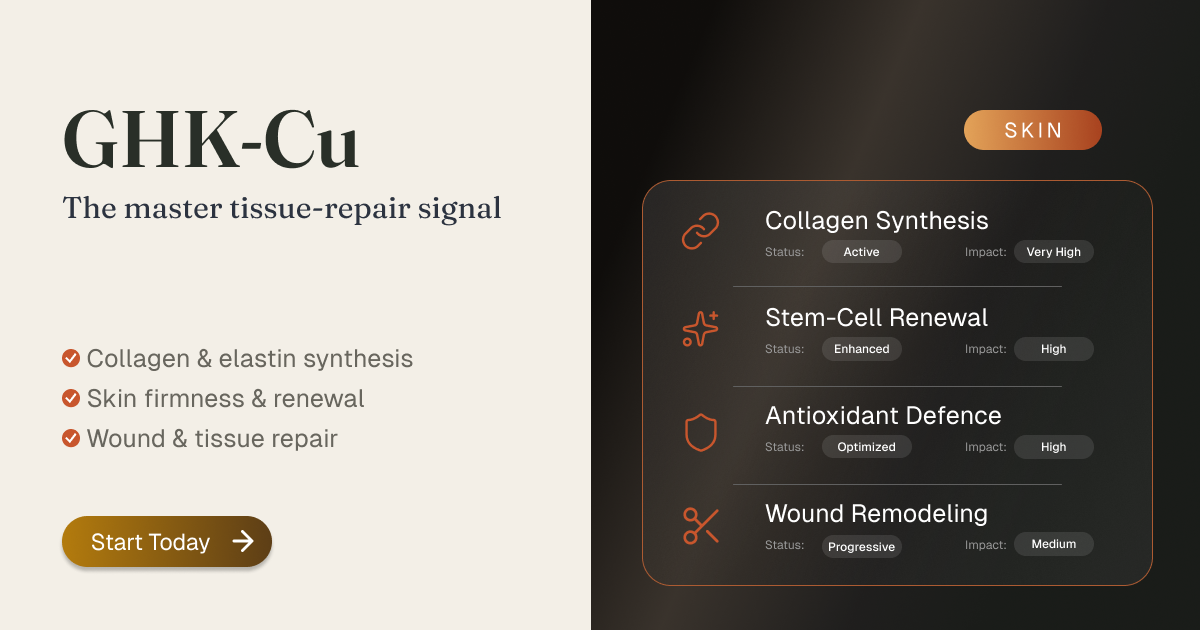
Master tissue repair signal — collagen, elastin, and stem cell renewal



Written by Beatrisse Fender & Toby Sorabjee · Reviewed by Lynn Marie Morski
Medically reviewed October 24, 2026
How it works
Class & mechanism.
In short
GHK-Cu is a naturally occurring copper-binding tripeptide found in human plasma that functions as a master tissue repair signal. It activates over 4,000 human genes involved in collagen production, antioxidant defense, and stem cell renewal — but its levels decline 60% by age 60. GHK-Cu is the active regenerative component of the Skin Glow blend.
Class
Copper-Binding Tripeptide (Tissue Regeneration Signal)
Mechanism
GHK-Cu (glycyl-L-histidyl-L-lysine copper complex) is a naturally occurring tripeptide-copper chelate found in human plasma, saliva, and urine that functions as a master tissue repair signal. It binds copper(II) with high affinity, and the resulting complex activates a remarkably broad transcriptional program: upregulating approximately 31% of genes involved in tissue remodeling, antioxidant defense, and stem cell activation, while downregulating roughly 18% of genes associated with inflammation, oxidative damage, and cancer progression. In skin specifically, GHK-Cu stimulates collagen, elastin, glycosaminoglycan, proteoglycan, and decorin synthesis in fibroblasts; activates matrix metalloproteinase (MMP) remodeling to clear damaged tissue; promotes angiogenesis for tissue repair; and increases keratinocyte and stem cell activity to restore epidermal barrier integrity. Beyond skin, GHK-Cu has been studied for wound healing, nerve regeneration, and systemic anti-inflammatory effects — its gene-level mechanism makes it one of the most broadly studied regenerative peptides.
Personalized Peptides provides DNA-driven peptide recommendations — we are not a compounding pharmacy, peptide synthesis company, or clinical provider.
Did you know
GHK-Cu was discovered in 1973 when a researcher noticed that aging human liver tissue started behaving like young tissue when exposed to a mystery fraction from young blood plasma — and that mystery molecule turned out to be a simple three-amino-acid copper complex your body already makes, that declines 60% by age 60.
Preclinical Data
No human PK studies available.
Human plasma concentration data exists — formal PK study parameters (t½, Vd, CL) not published
Class
Endogenous copper-binding tripeptide — tissue regeneration signal
Route
SC / Topical / Oral
Mol. Weight
340.4 Da
What we don't know
Pickart (1973) established baseline human plasma GHK-Cu concentrations and the age-related decline curve. The tripeptide is rapidly cleared from plasma (estimated t½ ~30 min based on peptide size and renal filtration), but tissue binding to copper transport proteins and extracellular matrix components extends biological activity well beyond plasma clearance. No formal PK compartment model exists. Topical formulations bypass first-pass metabolism entirely — dermal penetration is confirmed by cosmetic clinical studies showing collagen density improvements. Oral bioavailability is unknown but presumed low due to GI peptidase degradation of the tripeptide.
Why this dosing protocol
Injectable: 1-2mg SC daily produces supraphysiological GHK-Cu levels intended to restore plasma concentrations closer to youthful levels. Monday-Friday dosing with weekend breaks mirrors clinical cosmetic protocols and allows receptor resensitisation. Topical application delivers GHK-Cu directly to skin fibroblasts without systemic exposure — concentration varies by product (1-5%), applied 1-2× daily. Injectable and topical routes are often combined: injectable provides systemic regeneration signals, topical provides localised skin benefits. The 8-12 week protocol reflects the cumulative nature of collagen remodelling and gene expression changes.
Empirical protocol: 1-2mg SC daily (Mon-Fri); topical 1-5% 1-2×/day
Safety notes
- No formal PK compartment model
- Topical bioavailability not quantified
- Oral bioavailability unknown
Pharmacokinetic data shown for educational context. All parameters are inferred or empirically derived — no formal human PK studies exist for this compound. Individual response varies. Not a substitute for clinical dosing guidance.
Benefits
What it does.
Stimulates collagen and elastin production — preclinical and clinical cosmetic data suggest improvements in skin tightness, fine lines, and wrinkle depth
Activates over 4,000 human genes involved in tissue regeneration, antioxidant defense, and stem cell renewal per genome-wide analysis
Accelerates wound healing — preclinical evidence across diabetic, ischemic, and chronic wound models
Reduces hyperpigmentation and photodamage — clinical cosmetic studies report improvements in skin density, firmness, and UV protection markers
Plasma GHK-Cu concentrations decline approximately 60% between age 20 and 60 — depletion correlates with loss of regenerative capacity
The science
Peer-reviewed findings.
Research supporting this compound's mechanisms and safety profile.
What this does not mean
GHK-Cu is a research chemical and is not FDA-approved for cosmetic or anti-aging use. Injectable GHK-Cu is under FDA PCAC review (Feb 2027) and is not currently authorized for compounding. Topical GHK-Cu products may fall under different regulatory pathways. The information on this page is educational and does not constitute medical advice, diagnosis, or treatment. This page does not recommend, endorse, or prescribe any compound for human use. Always consult a qualified healthcare provider before making health decisions. Personalized Peptides provides DNA-driven educational context and test interpretation — not clinical protocols or pharmaceutical recommendations.
Genome-wide analysis showed GHK-Cu modulates the expression of over 4,000 human genes — upregulating genes for collagen, antioxidant enzymes, and stem cell markers (p53, integrins), while downregulating inflammation and oncogene pathways.
SOURCE · Pickart & Margolina, Cosmetics (MDPI) 2018; Frontiers in Aging Neuroscience
Clinical cosmetic studies confirmed GHK-Cu tightens loose skin, reverses thinning, improves elasticity, increases skin density, reduces fine lines and deep wrinkles, and protects against UV damage — with reproducible results across topical and injectable application forms.
SOURCE · Multiple clinical cosmetic studies (compiled in Pickart review, Biomed Research International 2015)
Plasma GHK-Cu concentrations decline from approximately 200 ng/mL at age 20 to roughly 80 ng/mL by age 60 — a 60% reduction that parallels the loss of regenerative capacity, suggesting GHK-Cu depletion is a measurable component of biological skin aging.
SOURCE · Pickart (1973); referenced in GHK-Cu clinical documentation
Protocol
How to use it.
Dosing
Injectable: 1–2 mg (0.03–0.06 mL) subcutaneous injection daily, typically Monday–Friday. Topical: applied to clean skin 1–2× daily; concentration varies by product (typically 1–5%). Topical and injectable routes may be combined — clinical cosmetic protocols report synergistic effects.
Cycle
Injectable protocols typically run 8–12 weeks, followed by a 4-week break before reassessment. Topical use may be maintained continuously. Benefits are cumulative — improvements in collagen density and skin quality build over months of consistent use.
Contraindications
When to skip it.
Generally excellent safety profile — GHK-Cu is endogenous and bioidentical. Possible injection site reactions (bruising, temporary redness). Excessive injectable doses may cause temporary skin sensitivity. Avoid in known copper hypersensitivity (rare). Wilson's disease (copper metabolism disorder) is a contraindication for high-dose injectable use.
Always cleared with your concierge before protocol start.
Regulatory Context
FDA compounding status.
| FDA Status | Risk Level | Compounding | Key Date |
|---|---|---|---|
| PCAC Review Feb 2027 | 🟡 Under Review | Awaiting PCAC — 503A eligibility review (Feb 2027). Topical: Category 1. | PCAC Feb 2027 |
Removed from Category 2 (Apr 23, 2026). Under second PCAC review Feb 2027 for injectable route. GHK-Cu topical is Category 1 for non-injectable routes — not affected by PCAC. Injectable needs PCAC clearance. Biggest breakout in catalogue (+1,010% YoY search growth).
Source: FDA Federal Register, PCAC agendas, industry analyses. Educational context only — not legal advice. Review after July 23-24, 2026 PCAC meeting.
Pricing
What it costs.
Indicative range for GHK-Cu, sourced from vetted US and EU dispensing suppliers. Concierge confirms the exact figure once your match is locked.
Indicative range (USD)
Sourced through vetted dispensing partners in the United States and European Union. Concierge confirms the exact figure once your match is locked.
- 0199% purity verified, third-party tested
- 02Includes vial and reconstitution guidance
- 03Concierge supplier match included with every protocol
See GHK-Cu pricing — and your supplier match.
Pricing is unlocked once we know who you are. Take the 3-minute quiz and we'll match you to a US or EU dispensary based on your location and protocol fit.
- Live USD price range
- US & EU supplier shortlist
- Concierge sign-off on dosing
Indicative price range: $104–$156 USD