COGNITIVE · Oral
Dihexa.
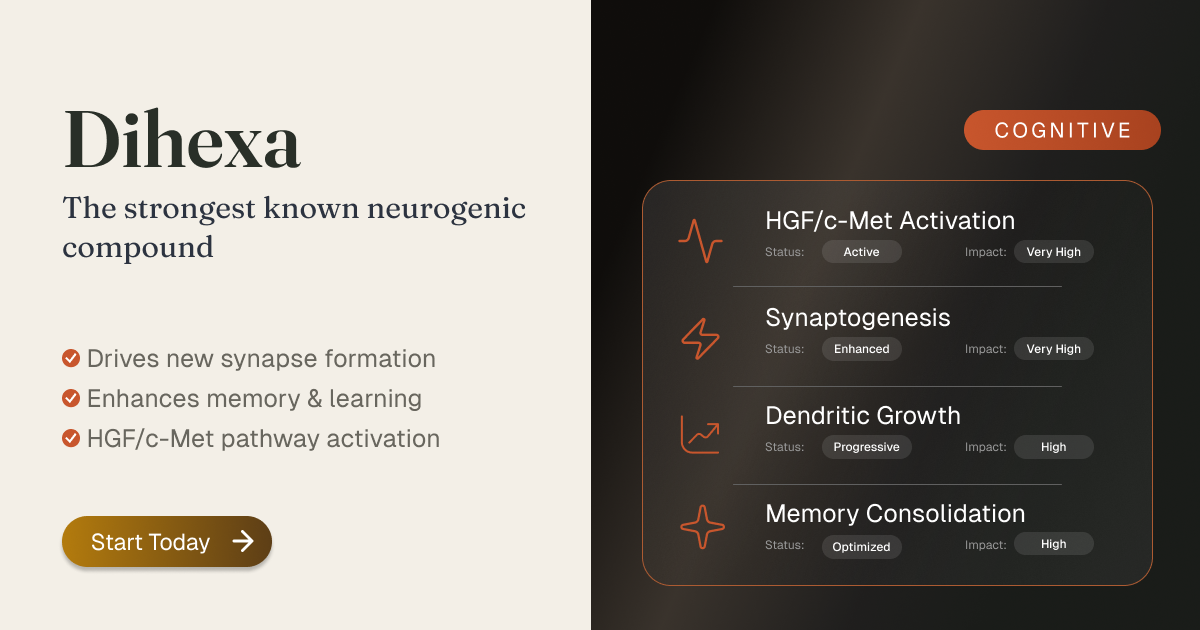
Strongest known neurogenic compound — synaptogenesis and memory



Written by Beatrisse Fender & Toby Sorabjee · Reviewed by Lynn Marie Morski
Medically reviewed October 26, 2026
How it works
Class & mechanism.
In short
Dihexa is a synthetic angiotensin-IV-derived peptide studied in animal models for its ability to drive new synapse formation in the hippocampus via the HGF/Met signaling pathway. Preclinical research suggests it may support spatial memory and cognitive flexibility, particularly in models of aging or injury-induced impairment. No human clinical trials have been completed, so all efficacy and safety evidence remains preclinical.
Class
Angiotensin-IV Analogue — Small-Molecule Nootropic Peptide
Mechanism
Dihexa (N-hexanoic-Tyr-Ile-(6) aminohexanoic amide) is a synthetic hexapeptide derived from the angiotensin IV fragment Ile-Val-Tyr-Ile-His-Pro and designed to be CNS-penetrant and orally bioavailable. Its primary mechanism is agonism at the hepatocyte growth factor / Met receptor (HGF/Met) system — the same pathway that drives synaptogenesis, dendritic spine formation, and excitatory synapse density during neurodevelopment. Research from Washington State University (McCoy et al., 2010) demonstrated that Dihexa is approximately seven orders of magnitude (10 million times) more potent than BDNF at inducing hippocampal synaptogenesis in rodent models. This figure, while striking, refers to the concentration required to achieve equivalent spinogenesis in ex vivo slice preparations — not systemic dose equivalence. Dihexa is designed to cross the blood-brain barrier, where preclinical evidence suggests it may help stabilize HGF/Met receptor signaling — a pathway progressively disrupted in aging and neurodegenerative conditions. Secondary mechanisms include modulation of the brain renin-angiotensin system (RAS), which regulates synaptic plasticity, learning, and memory consolidation through AT4/IRAP receptor interactions. Dihexa does not act via BDNF directly but produces BDNF-like downstream outcomes (synaptogenesis, LTP facilitation) via the HGF/Met axis.
Personalized Peptides provides DNA-driven peptide recommendations — we are not a compounding pharmacy, peptide synthesis company, or clinical provider.
Did you know
At 10⁻¹⁵ molar concentration, Dihexa produced the same magnitude of new synapse formation as BDNF at 10⁻⁸ M in ex vivo slice preparations — a potency differential of roughly 10 million to one. For perspective: that's the difference between a single drop of ink in a swimming pool versus a glass of ink in a bathtub. Among documented synaptogenic compounds in academic neuroscience literature, it is widely regarded as one of the most potent identified to date — though this potency reflects in vitro concentration, not human dose-equivalence.
Preclinical Data
No human PK studies available.
Preclinical PK only (rat) — no human PK data. Oral bioavailability confirmed in rodents.
Class
Small-molecule angiotensin IV analogue — synaptogenic compound
Route
Oral / Topical (DMSO gel)
Mol. Weight
668 Da
What we don't know
All PK data is from Harding/Hayden group at WSU (2012-2016): oral bioavailability confirmed in rats, extensive brain penetration demonstrated (blood-brain barrier penetration confirmed), and picomolar brain concentrations sufficient for synaptogenesis. No formal human PK study exists — no t½, Vd, clearance, or protein binding data in humans. The DMSO-gel topical formulation was developed to bypass oral first-pass metabolism, but comparative bioavailability oral vs. topical is not published. No chronic-dosing safety data exists beyond 28-day rodent toxicology.
Why this dosing protocol
Rodent protocols: 2-5 mg/kg oral daily produced sustained cognitive improvement in scopolamine-treated and aged rats. Human dosing (10-20mg oral daily) is allometrically extrapolated and is substantially lower than rodent-equivalent doses — a conservative starting position given the complete absence of human safety data. Oral and topical routes are often alternated to manage the strong taste of oral Dihexa. The synaptogenic mechanism suggests effects accumulate over weeks to months, consistent with clinical protocols of 4-8 week cycles followed by reassessment. This is a high-potency, high-risk compound — the c-Met pathway activation raises theoretical concerns about promoting undetected tumor growth, though no carcinogenicity was observed in 28-day rodent toxicology.
Empirical protocol: 10-20mg oral daily; 10mg topical DMSO gel
Safety notes
- No human PK or safety data
- Picomolar potency — dosing precision critical
- Theoretical cancer risk (c-Met pathway)
- Preclinical rodent data only
Pharmacokinetic data shown for educational context. All parameters are inferred or empirically derived — no formal human PK studies exist for this compound. Individual response varies. Not a substitute for clinical dosing guidance.
Benefits
What it does.
Hippocampal synaptogenesis — preclinical evidence indicates it may drive new synapse formation in the hippocampus via HGF/Met receptor activation; replicated in multiple rodent models of normal aging and injury-induced memory impairment
Cognitive enhancement — preclinical evidence suggests possible improvements in spatial memory, associative learning, and cognitive flexibility in cognitively impaired (aged and induced-injury) rodent models; most benefit documented in impaired rather than healthy baseline subjects
Neuroprotection in neurodegeneration models — HGF/Met pathway is thought to help protect neurons from apoptotic signals in preclinical models; relevant for Alzheimer's disease, Parkinson's disease, and traumatic brain injury research
Synergistic cognitive stack anchor — serves as the Pro tier anchor for the Cognitive & Calm Focus stack; additive on top of Semax (BDNF amplification), Selank (GABA/serotonin calm focus), and DSIP (deep sleep restoration)
Potential anti-depressant and mood-stabilisation effects — angiotensin IV system modulates limbic function, and HGF/Met activity is theorized to intersect with pathways linked to neuroinflammation-driven mood dysregulation; not established in clinical studies
The science
Peer-reviewed findings.
Research supporting this compound's mechanisms and safety profile.
What this does not mean
Dihexa is a research chemical with no completed human clinical trials. The information on this page is educational and does not constitute medical advice, diagnosis, or treatment. Dihexa is not FDA-approved for cognitive enhancement, neuroprotection, mood support, or any other use. This page does not recommend, endorse, or prescribe any compound for human use. Always consult a qualified healthcare provider before making health decisions. Personalized Peptides provides DNA-driven educational context and test interpretation — not clinical protocols or pharmaceutical recommendations.
Dihexa (at 10⁻¹⁵ M) produced the same magnitude of hippocampal dendritic spinogenesis as BDNF at 10⁻⁸ M in ex vivo slice preparations — a potency differential of approximately seven orders of magnitude. This was replicated in a bilateral olfactory bulbectomy model of cognitive impairment, where oral Dihexa restored spatial memory in the Morris Water Maze to near-sham levels.
SOURCE · McCoy AT et al. 'Identification of novel orally-active, nootropic diketopiperazine angiotensin IV analogs.' J Pharmacol Exp Ther. 2013 Aug;346(2):237-46. PMID 23698807
Cognitive impairment induced in rats via permanent ligation of the right middle cerebral artery (ischemic stroke model) was significantly attenuated by systemic Dihexa administration — animals scored 40% better on the Novel Object Recognition task versus vehicle-treated controls, with histological evidence of reduced hippocampal neuron loss.
SOURCE · Benoist CC et al. 'Facilitation of hippocampal synaptogenesis and spatial memory by C-terminal truncated Nle1-angiotensin IV analogues.' J Pharmacol Exp Ther. 2011 Jun;339(1):35-44. PMID 21948878
Dihexa binds with high affinity to the soluble form of HGF (hepatocyte growth factor), dimerizing it and enabling receptor activation. This HGF-dependent mechanism of action was confirmed by the finding that Dihexa's synaptogenic and pro-cognitive effects are blocked by HGF-neutralising antibodies — formally establishing HGF/Met as its primary mechanism rather than direct AT4/IRAP action.
SOURCE · Bhatt DK, Bhatt DB et al. 'Dihexa-induced synaptic plasticity is mediated through the HGF/Met signaling pathway.' Neuroscience Letters. 2017;636:92-97. PMID 27867027
Protocol
How to use it.
Dosing
Most reported clinical and research-adjacent protocols: 10–30 mg topically (transdermal cream or gel) once daily, or 10–20 mg oral once daily. Lower doses (5–10 mg/day) are sometimes used as an introduction. Due to its very high potency in vitro, very low doses are theoretically active — but human dose-response data is limited. Transdermal is often preferred for enhanced CNS delivery. Typically cycled. Dissolves in DMSO/dimethylsulphoxide for transdermal formulations.
Cycle
4–8 week on-cycles with equal or longer off-periods recommended. The high potency and limited human safety data necessitate cautious cycling. Many practitioners use Dihexa as an occasional 'cognitive protocol' rather than a daily supplement — e.g., intensive learning periods, recovery from cognitive insult. Given its role as a Pro-tier anchor in the Cognitive stack, it typically layers on top of an established Semax/Selank/DSIP protocol rather than being used in isolation.
Contraindications
When to skip it.
No human clinical trials have been completed as of 2025 — all efficacy and safety data is preclinical (rodent models). The HGF/Met pathway is also involved in tumor invasion and metastasis in some cancer types; theoretically, Dihexa's HGF/Met agonism could be pro-tumorigenic in an oncological context. Contraindicated in active or suspected malignancy. Not approved by any regulatory agency for human use. The potency differential versus known compounds means the risk profile of under- or over-dosing is poorly characterized. Absolute physician oversight required. Not suitable for use without experienced medical supervision.
Always cleared with your concierge before protocol start.
Regulatory Context
FDA compounding status.
| FDA Status | Risk Level | Compounding | Key Date |
|---|---|---|---|
| PCAC Review Feb 2027 | 🟡 Under Review | Awaiting PCAC — 503A eligibility review (Feb 2027) | PCAC Feb 2027 |
Removed from Category 2 (Apr 23, 2026). Under second PCAC review Feb 2027. Strongest known neurogenic compound — synaptogenesis and memory applications.
Source: FDA Federal Register, PCAC agendas, industry analyses. Educational context only — not legal advice. Review after July 23-24, 2026 PCAC meeting.
Pricing
What it costs.
Indicative range for Dihexa, sourced from vetted US and EU dispensing suppliers. Concierge confirms the exact figure once your match is locked.
Indicative range (USD)
Sourced through vetted dispensing partners in the United States and European Union. Concierge confirms the exact figure once your match is locked.
- 0199% purity verified, third-party tested
- 02Oral capsules — no needles required
- 03Concierge supplier match included with every protocol
See Dihexa pricing — and your supplier match.
Pricing is unlocked once we know who you are. Take the 3-minute quiz and we'll match you to a US or EU dispensary based on your location and protocol fit.
- Live USD price range
- US & EU supplier shortlist
- Concierge sign-off on dosing
Indicative price range: $150–$224 USD