RECOVERY · Injectable
BPC-157.
The most researched healing peptide



Written by Beatrisse Fender & Toby Sorabjee · Reviewed by Lynn Marie Morski
Medically reviewed October 25, 2026
How it works
Class & mechanism.
In short
BPC-157 is a synthetic 15-amino-acid peptide based on a protective protein found in human gastric juice. It is studied primarily as a tissue-repair compound, thought to work by promoting new blood vessel growth (angiogenesis) and activating repair pathways. Researchers most often examine it for tendon, ligament, muscle, and gut healing — though evidence to date is preclinical.
Class
Synthetic Peptide
Mechanism
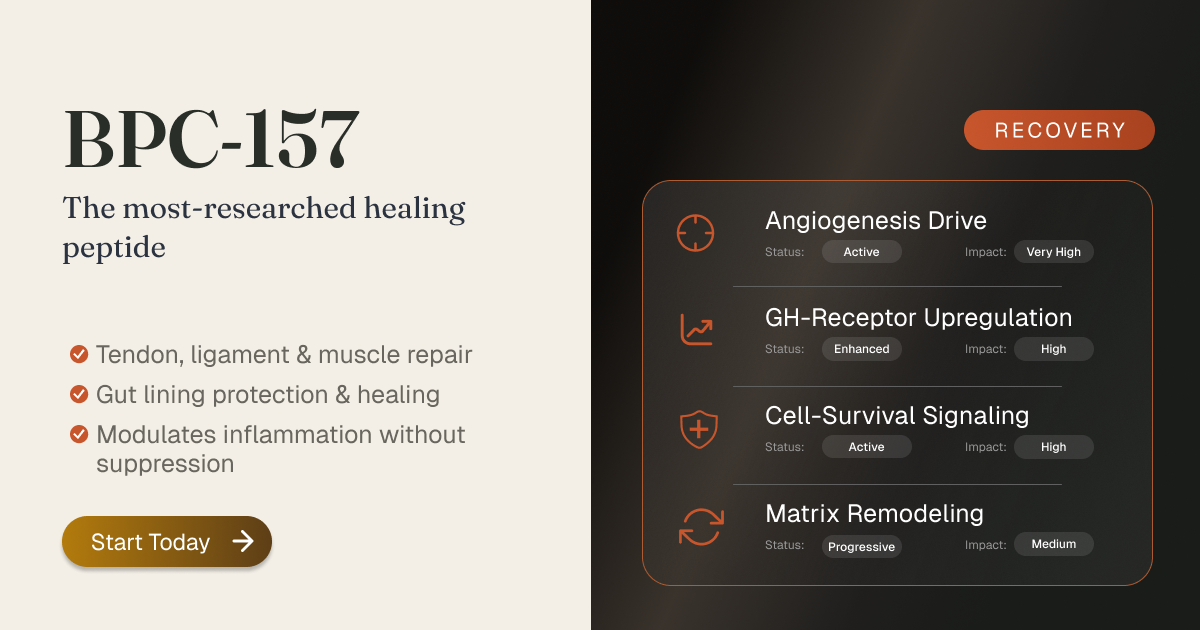
BPC-157 (Body Protection Compound-157) is a 15-amino acid sequence derived from a naturally occurring protein in human gastric juice. It activates multiple convergent repair pathways simultaneously: VEGFR2-mediated angiogenesis via FAK-paxillin signaling (driving endothelial cell migration and new vessel formation), upregulation of growth hormone receptor expression in tendon fibroblasts, Akt/PI3K cell survival signaling, and Egr-1 transcription factor activity that orchestrates extracellular matrix remodeling. Critically, it modulates the nitric oxide system to preserve protective vascular functions while suppressing cytotoxic inflammatory signaling — essentially acting as a tissue repair conductor across multiple organ systems simultaneously.
Personalized Peptides provides DNA-driven peptide recommendations — we are not a compounding pharmacy, peptide synthesis company, or clinical provider.
Did you know
BPC-157 is derived from a protein naturally present in human gastric juice — the same fluid that digests food — and it's so stable in stomach acid that it remains intact and active when swallowed, which is why it's one of the rare peptides reported to retain activity orally, not just by injection.
Preclinical Data
No human PK studies available.
No human PK data — 100+ preclinical papers, zero PK studies
Class
Synthetic gastric juice protective protein fragment
Route
SC / Oral
Mol. Weight
1,419.5 Da
What we don't know
Despite 100+ preclinical publications from the Zagreb group and widespread human use, no formal pharmacokinetic study exists in any species. All PK parameters (t½, bioavailability, Vd, clearance) are unknown. The peptide's remarkable potency at nanogram/kg doses in rodents further complicates dose extrapolation.
Why this dosing protocol
Human dosing is entirely empirical. Rodent studies show effects at 10 ng/kg-10 µg/kg/day; human clinical doses (200-1000mcg) are orders of magnitude higher than allometric scaling would predict but are well-tolerated. Twice-daily dosing is convention based on inferred short half-life from proteolytic sensitivity. Oral BPC-157 is biologically active in rodents despite presumed low bioavailability — gastric acid stability is confirmed but luminal peptidase degradation is likely significant.
Empirical protocol: 200-500mcg SC 1-2× daily; 500-1000mcg oral
Safety notes
- No human PK data
- All dosing is empirical
Pharmacokinetic data shown for educational context. All parameters are inferred or empirically derived — no formal human PK studies exist for this compound. Individual response varies. Not a substitute for clinical dosing guidance.
Benefits
What it does.
Accelerated musculoskeletal healing — in multiple preclinical injury models, tendons, ligaments, muscle, and bone may show improved outgrowth and biomechanical properties over a 14–21 day window
Gut mucosal repair and protection — preclinical evidence suggests BPC-157 may support healing of gastric ulcers, counter NSAID-induced mucosal damage, and help restore intestinal barrier integrity ('leaky gut')
Systemic inflammation modulation — may regulate inflammatory cell recruitment patterns and immune signaling without broadly suppressing immune function
Neuroprotective and gut-brain axis support — preclinical data suggests BPC-157 may help reverse neurotransmitter disruption and support CNS recovery in traumatic brain injury and stroke models
Coagulation and vascular stability — in animal models, BPC-157 may counteract bleeding disorders and support healing of deep vascular injury, organ perforations, and anti-coagulant complications
The science
Peer-reviewed findings.
Research supporting this compound's mechanisms and safety profile.
What this does not mean
BPC-157 is a research chemical. The information on this page is educational and does not constitute medical advice, diagnosis, or treatment. BPC-157 is not FDA-approved for treating injuries, gastrointestinal conditions, or any other use. This page does not recommend, endorse, or prescribe any compound for human use. Always consult a qualified healthcare provider before making health decisions. Personalized Peptides provides DNA-driven educational context and test interpretation — not clinical protocols or pharmaceutical recommendations.
BPC-157 significantly upregulates growth hormone receptor expression in tendon fibroblasts in a dose- and time-dependent manner, explaining its consistent ability to accelerate tendon-to-bone healing across multiple injury models
SOURCE · PMC6271067 — Frontiers in Pharmacology / PubMed Central; Chang et al., tendon outgrowth studies
In clinical trials for inflammatory bowel disease (PL-10, PLD-116, PL 14736), BPC-157 demonstrated safety in human subjects with no dose-limiting toxicity — the LD1 was never achieved even at high doses, making it one of the most safety-studied experimental peptides
SOURCE · ResearchGate / Sikiric et al.; PubMed 17713731
A 2024 narrative review (PMC12446177) confirmed BPC-157 exerts regenerative effects through multiple interconnected pathways including VEGFR2 angiogenesis, FAK-paxillin endothelial migration, and Egr-1 transcription factor activity — validating the multi-pathway repair model across musculoskeletal and neuromuscular tissues
SOURCE · PMC12446177 — Regeneration or Risk? A Narrative Review of BPC-157, 2024
Protocol
How to use it.
Dosing
250–500 mcg per day via subcutaneous injection (most common protocol). Can be split into two doses (morning and evening) for acute injuries. Oral/sublingual administration (500 mcg–1 mg daily) used specifically for gastrointestinal conditions where direct mucosal contact is desirable. Injection site is typically near the injury site or abdomen.
Cycle
4–8 weeks for acute injury healing; 8–12 weeks for chronic conditions or post-surgical recovery. Standard practice is to run a 4–6 week cycle, assess progress, then take a 4–6 week break before repeating if needed. No established long-term human cycling data exists.
Contraindications
When to skip it.
No human-approved dosing guidelines exist and no large-scale human RCTs have been completed as of 2025. Theoretical concern around angiogenesis in individuals with active or undiagnosed cancers (new vessel growth could theoretically support tumor progression — current preclinical evidence does not confirm this risk, but it warrants caution). Banned by WADA for competitive athletes. Use under physician supervision only.
Always cleared with your concierge before protocol start.
Regulatory Context
FDA compounding status.
| FDA Status | Risk Level | Compounding | Key Date |
|---|---|---|---|
| PCAC Review July 2026 | 🔴 At Risk | Awaiting PCAC — 503A eligibility review | PCAC July 23, 2026 |
Removed from Category 2 (Apr 23, 2026). Under PCAC review for 503A Bulks List eligibility. Even with favorable vote, formal compounding authorization requires 12-24 month notice-and-comment rulemaking. Currently in regulatory gray zone — not prohibited, not authorized.
Source: FDA Federal Register, PCAC agendas, industry analyses. Educational context only — not legal advice. Review after July 23-24, 2026 PCAC meeting.
Pricing
What it costs.
Indicative range for BPC-157, sourced from vetted US and EU dispensing suppliers. Concierge confirms the exact figure once your match is locked.
Indicative range (USD)
Sourced through vetted dispensing partners in the United States and European Union. Concierge confirms the exact figure once your match is locked.
- 0199% purity verified, third-party tested
- 02Includes vial and reconstitution guidance
- 03Concierge supplier match included with every protocol
See BPC-157 pricing — and your supplier match.
Pricing is unlocked once we know who you are. Take the 3-minute quiz and we'll match you to a US or EU dispensary based on your location and protocol fit.
- Live USD price range
- US & EU supplier shortlist
- Concierge sign-off on dosing
Indicative price range: $120–$180 USD