METABOLIC · Oral
5-Amino 1MQ.
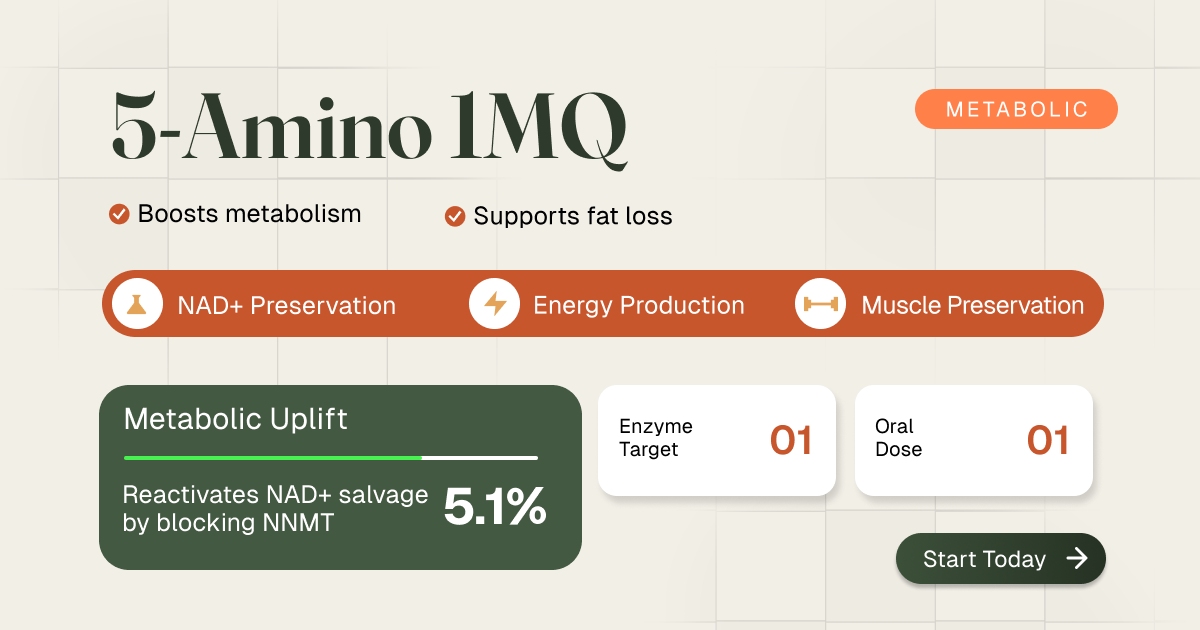
NNMT inhibitor for metabolic activation



Written by Beatrisse Fender & Toby Sorabjee · Reviewed by Lynn Marie Morski
Medically reviewed October 25, 2026
How it works
Class & mechanism.
In short
5-Amino-1MQ is a small molecule — not a peptide — that blocks an enzyme called NNMT, which fat cells use to burn through NAD+ and hoard energy. In animal studies, blocking NNMT raised intracellular NAD+ and shrank fat cells by 30–40% without any change in appetite or food intake. All efficacy data to date comes from preclinical models; no human clinical trials have been completed.
Class
NNMT Inhibitor (Small Molecule)
Mechanism
5-Amino-1MQ (5-amino-1-methylquinolinium) is a cell-membrane-permeable small molecule that selectively inhibits nicotinamide N-methyltransferase (NNMT) — an enzyme overexpressed in white adipose tissue under obese/high-fat conditions that converts nicotinamide to N-methylnicotinamide, consuming methyl groups and depleting intracellular NAD+. By blocking NNMT with an IC50 of ~1 µM without affecting other methyltransferases or cytochrome P450 enzymes, 5-Amino-1MQ preserves the nicotinamide pool for NAD+ synthesis, raising intracellular NAD+ levels 1.2–1.6 fold in adipocytes. Elevated NAD+ activates sirtuin deacetylases (particularly SIRT1 and SIRT3) and AMPK pathways, which shift adipocytes from a fat-storing to a fat-burning metabolic state, inhibit adipogenesis-related transcription factors (PPARγ, C/EBPα, SREBP1), and increase mitochondrial fatty acid oxidation and energy expenditure.
Personalized Peptides provides DNA-driven peptide recommendations — we are not a compounding pharmacy, peptide synthesis company, or clinical provider.
Did you know
Unlike every other weight-loss compound, 5-Amino-1MQ achieved fat cell shrinkage of 30–40% in animal models without any change in appetite, food intake, or hormone levels — purely by removing a metabolic 'brake' (the NNMT enzyme) that obese fat cells use to hoard energy. It appears to break the vicious cycle where excess fat literally produces more of the enzyme that makes it harder to lose fat.
Preclinical Data
No human PK studies available.
Best rat PK of any NNMT inhibitor — zero human PK or clinical trial data
Class
Small molecule NNMT inhibitor (quinolinium salt) — NOT a peptide
Route
Oral / SC
Mol. Weight
159.2 Da
What we don't know
Single rat PK study (Awosemo 2021) is the entirety of published pharmacokinetic literature. Oral F = 38.4% in rats, t½(oral) = 6.9h, Cmax = 2,252 ng/mL (oral 10mg/kg). Caco-2 permeability is high (34.2 × 10⁻⁶ cm/s) with no P-gp efflux — strongly predicts human oral absorption. No human PK, safety, or efficacy data exists. US clinics prescribe 50mg oral capsules off-label based entirely on rodent data.
Why this dosing protocol
Oral 50-150mg/day, split BID given ~7h half-life in rats. Mouse efficacy dose (20mg/kg 3×/day SC) allometrically scales to ~700mg/day for humans — clinical use at 50-150mg is far below this, suggesting conservative titration. Water-soluble (>100 mg/mL), no food co-administration needed. Typical community cycles: 8-12 weeks on / 4-8 weeks off (no evidence base, purely precautionary).
Empirical protocol: 50-150mg oral/day (clinical); 20mg/kg 3×/day SC (mouse efficacy)
Safety notes
- Not a peptide — small molecule
- Zero human data
- All dosing from rat PK extrapolation
Pharmacokinetic data shown for educational context. All parameters are inferred or empirically derived — no formal human PK studies exist for this compound. Individual response varies. Not a substitute for clinical dosing guidance.
Benefits
What it does.
Fat cell shrinkage without caloric restriction — adipocyte size reduced by 30–40% and volume by over 40% in obese animal models
Visceral and subcutaneous white fat reduction in animal models — targeting the most metabolically dangerous fat depots
Increased NAD+ levels (1.2–1.6x) in preclinical models, activating anti-aging sirtuins (SIRT1/SIRT3) and improving mitochondrial efficiency
Total cholesterol reduction ~30% and normalized lipid profiles in treated animals
Lipogenesis (new fat formation) inhibited by up to 70% in adipocytes from treated subjects
Muscle function and recovery enhancement — 2024 study showed additive grip strength improvements with exercise in aged mice
The science
Peer-reviewed findings.
Research supporting this compound's mechanisms and safety profile.
What this does not mean
5-Amino-1MQ is a small-molecule research chemical — not a peptide. The information on this page is educational and does not constitute medical advice, diagnosis, or treatment. 5-Amino-1MQ is not FDA-approved for weight management, metabolic support, or any other use, and no human clinical trials have been completed. This page does not recommend, endorse, or prescribe any compound for human use. Always consult a qualified healthcare provider before making health decisions. Personalized Peptides provides DNA-driven educational context and test interpretation — not clinical protocols or pharmaceutical recommendations.
Neelakantan et al. (2017/2018): Mice given 5-Amino-1MQ (20 mg/kg SC, 3×/day) for 11 days lost 5.1% body weight while controls gained 1.4%, with >30% reduction in adipocyte size, >40% reduction in adipocyte volume, and ~30% lower total cholesterol — no change in food intake
SOURCE · Biochemical Pharmacology / Scientific Reports, Neelakantan et al., 2017; PMC5826726
Kraus et al. (Nature Medicine): NNMT inhibition in white adipose tissue increased energy expenditure and reduced fat mass in animal models without altering food intake or physical activity, confirming the metabolic re-wiring mechanism
SOURCE · Nature Medicine, Kraus et al.
Waterson et al. (2022): NNMT inhibition combined with calorie restriction established a distinct gut microbiome profile in diet-induced obese mice, suggesting additional metabolic and immune benefits beyond direct fat metabolism
SOURCE · Nature Communications, Waterson et al., 2022
Dimet-Wiley et al. (2024, Scientific Reports): NNMT inhibition with 5-Amino-1MQ mimicked and additively boosted exercise-mediated improvements in muscle function in aged mice, with unique proteomic signatures suggesting applications in sarcopenia
SOURCE · Scientific Reports, Dimet-Wiley et al., 2024 (PMID: 38969654)
Protocol
How to use it.
Dosing
Research compound only — no approved human dosing. Preclinical animal protocol: 20 mg/kg subcutaneous, 3×/day for 11 days. Practitioner-adapted human protocols typically use 50 mg oral capsules, 1–2× daily (50–100 mg/day total). Standard starting dose: 50 mg/day for tolerance assessment, titrating to 100 mg/day if well-tolerated. Oral capsule form — no injection required.
Cycle
Typical research/wellness cycle: 4–6 weeks on, followed by 2–4 week break. Avoid dosing close to bedtime as NAD+ elevation may affect circadian signaling. Not FDA-approved; classified as a research chemical. No human clinical trials registered or completed as of 2024. All efficacy data from rodent models.
Contraindications
When to skip it.
No formal human safety data. No FDA approval or clinical trial data in humans. Preclinical animal studies showed favorable safety profile with no adverse hepatic effects at efficacy doses. Highly selective for NNMT vs other methyltransferases, reducing theoretical off-target risk. Use with caution in patients on medications affecting NAD+ metabolism (e.g., niacin, NMN). Not recommended during pregnancy or breastfeeding. Consult a healthcare provider before use.
Always cleared with your concierge before protocol start.
Regulatory Context
FDA compounding status.
| FDA Status | Risk Level | Compounding | Key Date |
|---|---|---|---|
| Not a peptide — small molecule NNMT inhibitor | 🟢 Stable | Not subject to peptide compounding regulations | No pending dates |
5-Amino-1MQ is a small molecule NNMT inhibitor, not a peptide. Not subject to FDA peptide compounding categories. Research-stage compound for metabolic activation.
Source: FDA Federal Register, PCAC agendas, industry analyses. Educational context only — not legal advice. Review after July 23-24, 2026 PCAC meeting.
Pricing
What it costs.
Indicative range for 5-Amino 1MQ, sourced from vetted US and EU dispensing suppliers. Concierge confirms the exact figure once your match is locked.
Indicative range (USD)
Sourced through vetted dispensing partners in the United States and European Union. Concierge confirms the exact figure once your match is locked.
- 0199% purity verified, third-party tested
- 02Oral capsules — no needles required
- 03Concierge supplier match included with every protocol
See 5-Amino 1MQ pricing — and your supplier match.
Pricing is unlocked once we know who you are. Take the 3-minute quiz and we'll match you to a US or EU dispensary based on your location and protocol fit.
- Live USD price range
- US & EU supplier shortlist
- Concierge sign-off on dosing
Indicative price range: $189–$283 USD