COGNITIVE · Spray
AC-Semax-NH2.
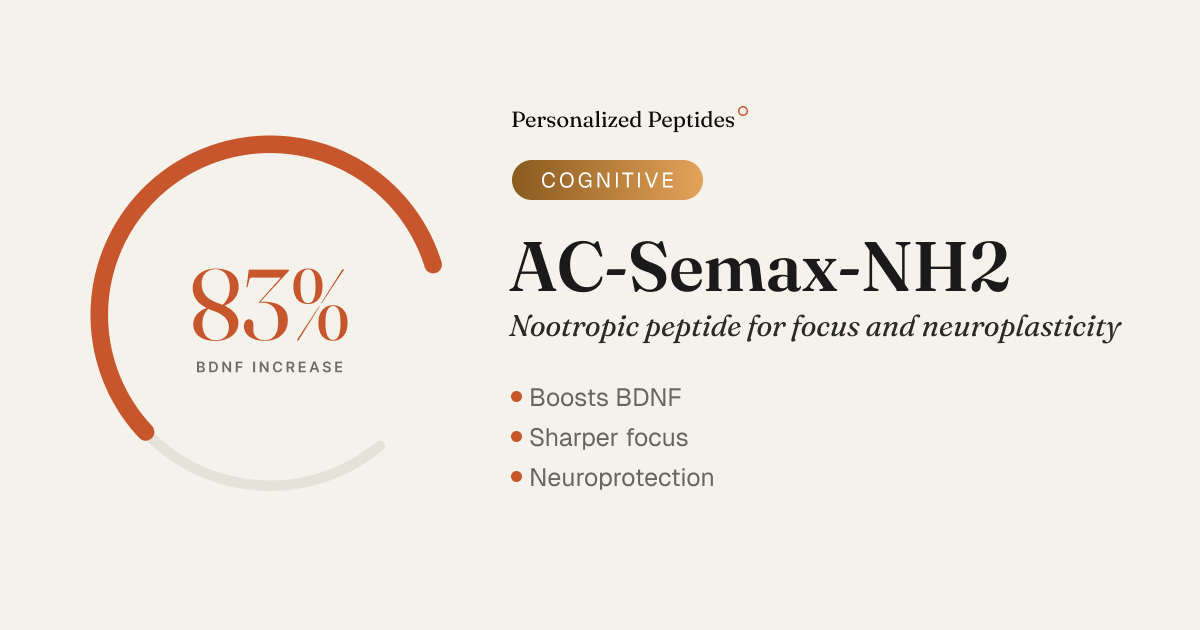
Nootropic peptide for focus and neuroplasticity



Written by Beatrisse Fender & Toby Sorabjee · Reviewed by Lynn Marie Morski
Medically reviewed September 10, 2026
How it works
Class & mechanism.
In short
AC-Semax is an acetylated derivative of the ACTH(4-7) fragment, developed in Russia and studied for its potential to support focus, working memory, and mental clarity through rapid BDNF and NGF upregulation. Clinical research from Russian stroke-recovery trials suggests it may aid neurological recovery after stroke or hypoxic injury, though independent replication outside Russia is limited. As a nootropic, it is most often discussed for non-stimulant cognitive and focus support rather than as a treatment for any diagnosed condition.
Class
Synthetic Neuropeptide (Acetylated ACTH Analogue)
Mechanism
AC-Semax-NH2 is an N-acetylated, C-terminal amidated derivative of the ACTH(4-7) fragment, engineered for enhanced blood-brain barrier penetration and metabolic stability. Once in the CNS, preclinical evidence indicates it may upregulate BDNF and NGF gene expression in the hippocampus and frontal cortex within 20 minutes of administration, potentially driving neuroplasticity and neurotrophic cascades. It also appears to modulate dopaminergic, serotonergic, and noradrenergic neurotransmission, with research suggesting increased concentrations of these monoamines in key cognitive regions alongside support for neuronal survival under hypoxic conditions.
Personalized Peptides provides DNA-driven peptide recommendations — we are not a compounding pharmacy, peptide synthesis company, or clinical provider.
Did you know
Semax was originally developed by the Russian Academy of Sciences in the 1970s and is still prescribed in Russian hospitals today for stroke recovery — research suggests it may upregulate the brain's primary growth factor (BDNF) within 20 minutes of a single nasal spray.
Preclinical Data
No human PK studies available.
Russian clinical data only — intranasal PK inferred from pharmacodynamic studies
Class
N-acetylated ACTH(4-10) analogue — nootropic neuropeptide
Route
Intranasal / SC
Mol. Weight
856 Da
What we don't know
Russian clinical trials established intranasal bioavailability and CNS penetration through olfactory-to-CSF transport — concentrations in CSF reach ~60% of plasma levels within 30 min for standard Semax. AC-Semax-NH2 is estimated to have 3-5× longer effective half-life than standard Semax (~1-2 hours intranasal based on BDNF/NGF expression duration). No Western clinical trials exist. No formal PK compartment model with Vd, CL, or absolute bioavailability measurements has been published. Most data is in Russian-language journals.
Why this dosing protocol
Standard dosing: 200-500mcg intranasal per session, 1-3× daily based on Russian clinical protocols for stroke rehabilitation and cognitive impairment. Split dosing (2-3× daily) maintains more stable nootropic effect than single dose. The intranasal route is preferred due to direct brain access via olfactory epithelium and cribriform plate — bypassing systemic metabolism and blood-brain barrier entirely. AC-Semax's enhanced stability allows lower effective doses than standard Semax. Protocol duration: 2-4 weeks for acute cognitive support, 4-8 weeks for neurorehabilitation. Non-stimulant — no crash, tolerance, or dependency reported.
Empirical protocol: 200-500mcg intranasal 1-3× daily; 100-300mcg SC
Safety notes
- Russian-only clinical data
- No Western replication
- Limited long-term human data
Pharmacokinetic data shown for educational context. All parameters are inferred or empirically derived — no formal human PK studies exist for this compound. Individual response varies. Not a substitute for clinical dosing guidance.
Benefits
What it does.
Nootropic focus support — studied for potential enhancement of focus, working memory, and mental clarity via rapid BDNF/NGF signaling changes
Upregulates BDNF and NGF — preclinical evidence suggests it may increase expression of the brain's own growth factors for plasticity and repair
Neuroprotection — clinical research from Russian stroke-recovery trials suggests it may help accelerate neurological recovery after stroke and hypoxic injury, though rigor and blinding of these trials vary
Non-stimulant cognitive support — reported by users and practitioners to avoid the crash, dependency, or tolerance patterns associated with stimulant-based nootropics; this observation has not been formally studied in controlled human trials
The science
Peer-reviewed findings.
Research supporting this compound's mechanisms and safety profile.
What this does not mean
AC-Semax is a research chemical. The information on this page is educational and does not constitute medical advice, diagnosis, or treatment. AC-Semax is not FDA-approved for cognitive enhancement, focus support, neuroprotection, or any other use. This page does not recommend, endorse, or prescribe any compound for human use. Always consult a qualified healthcare provider before making health decisions. Personalized Peptides provides DNA-driven educational context and test interpretation — not clinical protocols or pharmaceutical recommendations.
Single intranasal administration (50 mg/kg in rats) significantly altered BDNF and NGF mRNA levels in both hippocampus and frontal cortex within 20 minutes, with sustained expression changes over several hours.
SOURCE · Europe PMC / Zhurnal Vysshei Nervnoi Deyatelnosti, PMID 18756821
Meta-analysis of Russian clinical trials found Semax (12–18 mg/day intranasal) added to standard care improved neurological deficits faster after acute stroke; 83% of patients in one 69-patient series showed symptom regression mid-first week, with cognitive improvement 4–7 days earlier than controls.
SOURCE · Russian clinical trial meta-analysis (multiple centers)
Semax increases selective attention and memory storage and promotes neuron survival under hypoxia through ACTH(4-7) receptor-mediated signaling and downstream neurotrophic factor induction.
SOURCE · Neuropeptides / European PMC review literature
Protocol
How to use it.
Dosing
200–600 mcg intranasal per session (split across both nostrils); or 100–300 mcg subcutaneous injection. Standard cognitive protocol: once daily in the morning. Clinical neuroprotection doses reach 12–18 mg/day but are medical-only.
Cycle
10–14 day cycles are most common; followed by 7–14 days off. Some protocols use 5 days on / 2 days off. Long-term continuous use not recommended without breaks.
Contraindications
When to skip it.
Avoid in pregnancy or breastfeeding. Use caution with pre-existing psychiatric conditions (anxiety, psychosis) as dopamine/noradrenaline enhancement may be activating. Not recommended in combination with MAOIs or stimulants without supervision.
Always cleared with your concierge before protocol start.
Regulatory Context
FDA compounding status.
| FDA Status | Risk Level | Compounding | Key Date |
|---|---|---|---|
| PCAC Review July 2026 | 🔴 At Risk | Awaiting PCAC — 503A eligibility review | PCAC July 24, 2026 |
Removed from Category 2 (Apr 23, 2026). Under PCAC review July 24. Cognitive nasal duo anchor with AC-Selank. Gray zone until formal 503A listing.
Source: FDA Federal Register, PCAC agendas, industry analyses. Educational context only — not legal advice. Review after July 23-24, 2026 PCAC meeting.
Pricing
What it costs.
Indicative range for AC-Semax-NH2, sourced from vetted US and EU dispensing suppliers. Concierge confirms the exact figure once your match is locked.
Indicative range (USD)
Sourced through vetted dispensing partners in the United States and European Union. Concierge confirms the exact figure once your match is locked.
- 0199% purity verified, third-party tested
- 02Nasal spray, ready to use
- 03Concierge supplier match included with every protocol
See AC-Semax-NH2 pricing — and your supplier match.
Pricing is unlocked once we know who you are. Take the 3-minute quiz and we'll match you to a US or EU dispensary based on your location and protocol fit.
- Live USD price range
- US & EU supplier shortlist
- Concierge sign-off on dosing
Indicative price range: $99–$149 USD