WEIGHT LOSS · Injectable
Tirzepatide.
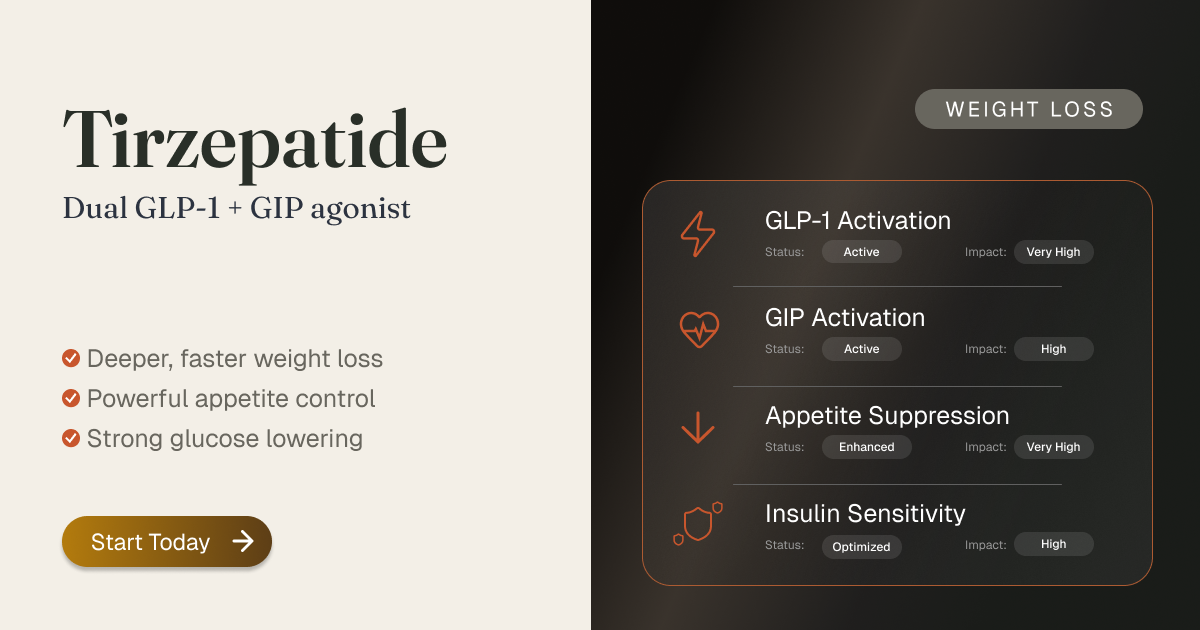
Dual GLP-1 + GIP agonist — deeper loss, faster onset



Written by Beatrisse Fender & Toby Sorabjee · Reviewed by Lynn Marie Morski
Medically reviewed October 25, 2026
How it works
Class & mechanism.
In short
Tirzepatide is a dual GIP/GLP-1 receptor agonist FDA-approved as Mounjaro (type 2 diabetes) and Zepbound (chronic weight management). Its two-receptor mechanism produced up to 22.5% body weight loss at the 15mg dose in SURMOUNT-1 and outperformed semaglutide head-to-head on both weight loss and A1C reduction in SURPASS-2. Compounded tirzepatide formulations exist outside these approved brand-name products and carry different regulatory status.
Class
Dual GIP/GLP-1 Receptor Agonist — Incretin Mimetic
Mechanism
Tirzepatide (brand: Mounjaro for T2DM, Zepbound for obesity) is a 39-amino acid synthetic peptide that is the first approved dual agonist of both the glucose-dependent insulinotropic polypeptide receptor (GIPR) and the glucagon-like peptide-1 receptor (GLP-1R). Unlike pure GLP-1 receptor agonists (semaglutide, liraglutide), tirzepatide activates two distinct incretin pathways simultaneously. At GIPR: reduces fasting glucose, augments insulin secretion in a glucose-dependent manner, suppresses glucagon, and modulates adipose tissue lipolysis and energy expenditure. At GLP-1R: slows gastric emptying (prolonging satiety signals), reduces appetite via hypothalamic arcuate nucleus signaling, improves insulin sensitivity in peripheral tissues, and reduces hepatic glucose output. The combination produces synergistic rather than merely additive effects — GIPR and GLP-1R co-activation in adipose tissue produces greater fat oxidation and mitochondrial biogenesis than either receptor alone. Tirzepatide's GIP activity also appears to partially attenuate the nausea and GI adverse effects of pure GLP-1 agonism, explaining its marginally better tolerability profile than equivalent-efficacy doses of semaglutide. FDA-approved for type 2 diabetes (May 2022, NDA 215866) and obesity (November 2023, NDA 217806).
Personalized Peptides provides DNA-driven peptide recommendations — we are not a compounding pharmacy, peptide synthesis company, or clinical provider.
Did you know
Tirzepatide is the first drug to hit two separate hormone receptors (GIP and GLP-1) simultaneously — and the weird part is that GIP was long thought to be a 'useless' incretin that did nothing for weight loss. The breakthrough was discovering that activating GIP and GLP-1 together does something neither does alone: it specifically triggers fat cell mitochondria to burn harder. That double-receptor discovery turned a failed diabetes compound into the most effective approved weight-loss drug in pharmaceutical history.
Half-life
120 h
Bioavailability
80%
Tmax
24 h
Cmax
60 nmol/L
Route
SC
Molecular weight
4814 Da
Pharmacokinetic data shown for educational context. Individual response varies. Not a substitute for clinical dosing guidance.
Benefits
What it does.
Superior weight loss — mean ~16.8% body weight reduction at 52 weeks (SURMOUNT-1: 22.5% at maximum dose, 15mg weekly) versus ~15% for semaglutide 2.4mg — the strongest approved dual-agonist weight-loss agent available
HbA1c reduction in T2DM — mean A1C reduction of 2.0–2.3% across SURPASS trial program, the strongest glucose-lowering data for any GLP-1 class agent in head-to-head comparison
Visceral adiposity reduction — GIPR activity drives specific visceral fat reduction in addition to total fat mass loss; MRI studies in the SURPASS and SURMOUNT programs confirm disproportionate VAT loss relative to total weight loss
Lean mass preservation — GIP receptor activity appears to partially protect lean muscle mass relative to pure GLP-1 agonists; used in combination with tesamorelin/ipamorelin (Performance cross-stack) for maximum muscle preservation during weight loss
Cardiovascular risk reduction — SURPASS-CVOT and SURMOUNT-5 data demonstrates improvements in lipid profiles, blood pressure, and inflammatory markers; SURPASS-4 showed 85% RRR in MACE in a high-CV-risk T2DM population
The science
Peer-reviewed findings.
Research supporting this compound's mechanisms and safety profile.
What this does not mean
Tirzepatide is FDA-approved as Mounjaro for type 2 diabetes management and as Zepbound for chronic weight management in adults with obesity or overweight with a weight-related condition. The 2022–2023 shortage under the FDA's compounding exception has been resolved, and bulk compounding of tirzepatide under that shortage exception has ended. Compounded formulations combining tirzepatide with additional components (such as B12, glycine, or NAD+) may qualify as 503A patient-specific preparations when structurally differentiated from the FDA-approved products, subject to state pharmacy board and FDA oversight. This page describes educational context only and does not recommend, endorse, or prescribe any compound. Always consult a qualified healthcare provider.
In the SURMOUNT-1 phase 3 trial (2,539 adults with obesity, no T2DM), tirzepatide 5mg/10mg/15mg produced mean body-weight reductions of 15.0%/19.5%/20.9% respectively at 72 weeks vs 3.1% placebo. At 15mg: 57% of participants lost ≥20% body weight. This remains the highest weight-loss efficacy ever observed in a phase 3 trial for a non-surgical intervention.
SOURCE · Jastreboff AM et al. 'Tirzepatide once weekly for the treatment of obesity.' NEJM. 2022;387(3):205-216. PMID 35658024. NCT04184622
Network meta-analysis of 12 RCTs (SUN-659, PMC12544991) comparing tirzepatide vs retatrutide in obesity: tirzepatide produced mean weight reduction of 16.79% (MD -16.79, 95% CI [-19.62; -13.95]) with adverse-event relative risk of 2.78 vs placebo — significantly lower AE burden than retatrutide (RR 4.10) for comparable weight-loss depth, establishing tirzepatide as the optimal efficacy-tolerability balance in the GLP-1 class.
SOURCE · SUN-659 Network Meta-Analysis — Comparative Efficacy and Safety of Tirzepatide vs Retatrutide. PMC12544991
SURPASS-2 head-to-head phase 3 trial compared tirzepatide (5/10/15mg) vs semaglutide 1mg weekly in 1,879 T2DM patients: tirzepatide produced 2.01/2.24/2.30% A1C reductions vs 1.86% for semaglutide; weight loss 7.6/9.3/11.2 kg vs 5.7 kg. All tirzepatide doses significantly superior to semaglutide in both endpoints (p<0.001 for all comparisons).
SOURCE · Frias JP et al. 'Tirzepatide versus semaglutide once weekly in patients with type 2 diabetes.' NEJM. 2021;385(6):503-515. PMID 34170647. NCT03987919
Tirzepatide's dual receptor mechanism produces fat cell effects beyond either agonist alone: in primary human adipocytes, GIP+GLP-1 co-stimulation increased mitochondrial biogenesis markers (PGC-1α, TFAM) and fatty acid oxidation rates by ~40% over GLP-1R agonism alone, partially explaining tirzepatide's superior visceral fat reduction profile in SURMOUNT imaging substudies.
SOURCE · Willard FS et al. 'Tirzepatide is an imbalanced and biased dual GIP and GLP-1 receptor agonist.' JCI Insight. 2020;5(21):e140532. PMID 33048844
Protocol
How to use it.
Dosing
FDA-approved starting dose: 2.5 mg subcutaneous injection once weekly for 4 weeks, then escalate by 2.5 mg increments every 4 weeks to target dose of 5–15 mg weekly. Maintenance dose is the highest tolerated dose up to 15 mg. Administered in thigh, abdomen, or upper arm. Dose escalation schedule is designed to minimize GI side effects (nausea, vomiting, diarrhoea) — the most common reason for discontinuation. Compounded tirzepatide vials: typically dosed in mcg (2500 mcg = 2.5 mg). Once weekly injection timing is flexible (same day each week, any time of day).
Cycle
Tirzepatide is approved for continuous long-term use — it is not cycled in the traditional peptide sense. However, many compounding-protocol users run 3–6 month courses with medication holidays to reassess metabolic status. Weight regain after discontinuation is expected (60–80% of lost weight typically returns within 12 months off treatment per clinical data) — this frames tirzepatide as a long-term metabolic management tool rather than a finite course. In the context of the Weight Loss stack, the Adjunct tier (tesamorelin/ipamorelin) for muscle preservation can be run concurrently or in alternating blocks.
Contraindications
When to skip it.
Contraindicated with personal or family history of medullary thyroid carcinoma (MTC) or Multiple Endocrine Neoplasia syndrome type 2 (MEN 2) — FDA black-box warning based on rodent thyroid C-cell tumor findings (not confirmed in humans but precautionary). Contraindicated in pancreatitis history (GLP-1 class class effect). Not recommended in combination with other GLP-1 receptor agonists, insulin secretagogues (without dose reduction), or other GIP/GLP-1 agonists. Hypoglycaemia risk when combined with insulin or sulfonylureas — requires dose adjustment of concomitant agents. Severe GI adverse events (nausea, vomiting, constipation) in ~30–40% of patients during dose escalation — meal timing, dose-reduction, and anti-nausea management important. Gallbladder disease (cholelithiasis, cholecystitis) — class effect, increased incidence with rapid weight loss. Diabetic retinopathy complication risk with rapid glycaemic improvement in T2DM with pre-existing retinopathy.
Always cleared with your concierge before protocol start.
Regulatory Context
FDA compounding status.
| FDA Status | Risk Level | Compounding | Key Date |
|---|---|---|---|
| FDA-Approved (Mounjaro/Zepbound) | 🟢 Stable | 503A patient-specific only (stacked formulations) | Shortage resolved Oct 2024 |
FDA-approved dual GLP-1/GIP receptor agonist. Shortage resolved — compounding essentially copies ended. Same 503A stacking pathway as semaglutide. Court backed FDA in Tirzepatide compounding case (May 2026). 503B bulk pathway being permanently closed.
Source: FDA Federal Register, PCAC agendas, industry analyses. Educational context only — not legal advice. Review after July 23-24, 2026 PCAC meeting.
Pricing
What it costs.
Indicative range for Tirzepatide, sourced from vetted US and EU dispensing suppliers. Concierge confirms the exact figure once your match is locked.
Indicative range (USD)
Sourced through vetted dispensing partners in the United States and European Union. Concierge confirms the exact figure once your match is locked.
- 0199% purity verified, third-party tested
- 02Includes vial and reconstitution guidance
- 03Concierge supplier match included with every protocol
See Tirzepatide pricing — and your supplier match.
Pricing is unlocked once we know who you are. Take the 3-minute quiz and we'll match you to a US or EU dispensary based on your location and protocol fit.
- Live USD price range
- US & EU supplier shortlist
- Concierge sign-off on dosing
Indicative price range: $129–$193 USD