IMMUNE · Injectable
Thymosin Alpha-1.
Immune modulating thymic peptide



Written by Beatrisse Fender & Toby Sorabjee · Reviewed by Lynn Marie Morski
Medically reviewed October 25, 2026
How it works
Class & mechanism.
In short
Thymosin Alpha-1 is a thymus-derived peptide licensed as the prescription drug Zadaxin in more than 30 countries, primarily for immune modulation. It works through Toll-like receptors on dendritic cells to help restore T-cell function, and has been studied in over 11,000 patients across trials for chronic viral infection, cancer adjunct therapy, and vaccine response enhancement. Despite this unusually deep evidence base, it is not FDA-approved in the United States and its use here is for research and educational purposes only.
Class
Thymic Immune Modulator Peptide
Mechanism
Thymosin Alpha-1 (Tα1, thymalfasin) is a 28-amino acid peptide originally isolated from bovine thymus tissue that acts through Toll-like receptors 2 and 9 (TLR2/TLR9) on myeloid and plasmacytoid dendritic cells. Activation triggers downstream signaling cascades that stimulate T-cell differentiation, development, and maturation — particularly enhancing Th1-biased immune responses, natural killer cell activity, and cytotoxic T-lymphocyte function. Tα1 also promotes production of key immune cytokines (IFN-γ, IL-2) while establishing a regulatory environment that balances inflammation and tolerance via tryptophan catabolism pathways. Its pleiotropic mechanism simultaneously stimulates deficient immune responses and moderates overactive autoimmune signaling.
Personalized Peptides provides DNA-driven peptide recommendations — we are not a compounding pharmacy, peptide synthesis company, or clinical provider.
Did you know
Thymosin Alpha-1 is approved as a prescription drug in over 30 countries and has been given to more than 11,000 patients in clinical trials — making it one of the best-evidenced peptides in this entire category, yet it remains largely unknown in Western longevity medicine.
Half-life
2 h
Bioavailability
60%
Tmax
1.5 h
Cmax
80 ng/mL
Route
SC
Molecular weight
3108 Da
Pharmacokinetic data shown for educational context. Individual response varies. Not a substitute for clinical dosing guidance.
Benefits
What it does.
May help restore T-cell populations and immune competence in aging, post-chemotherapy, and immunocompromised states
Enhances vaccine response — clinical trials reported improved antibody production in elderly and hemodialysis patients receiving Tα1 alongside influenza and hepatitis B vaccines
Anti-tumor activity via multiple pathways: evidence suggests it may inhibit cancer cell proliferation, induce tumor cell apoptosis, promote immunosurveillance, and counteract immunosuppression caused by cancer treatments
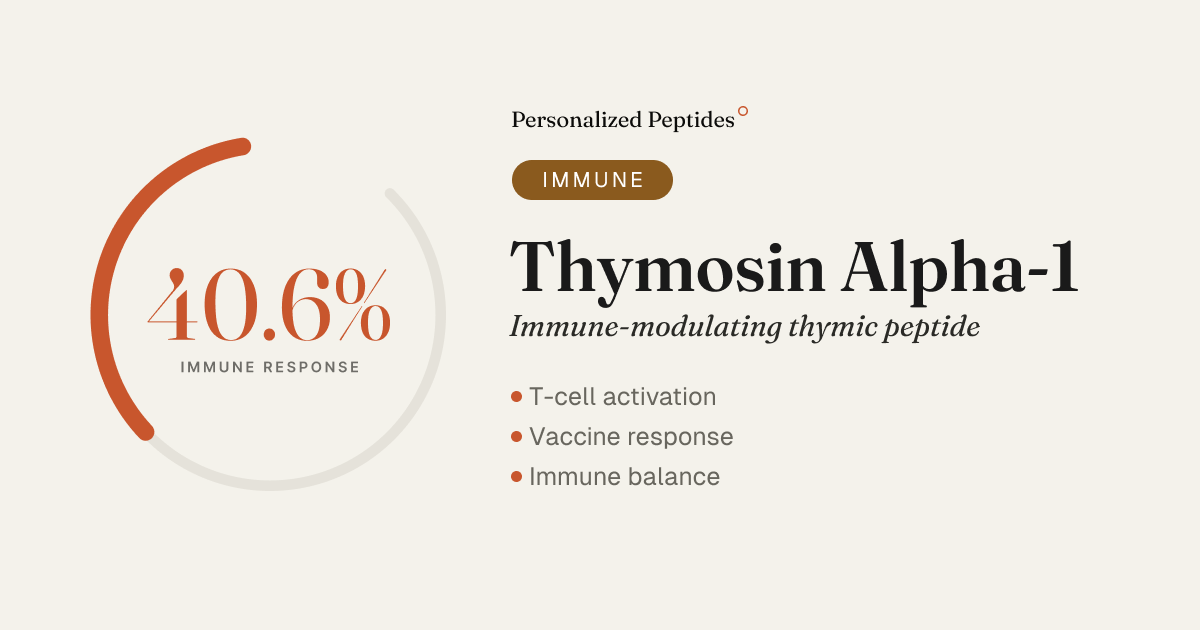
Modulates chronic viral infections (hepatitis B and C) — in trials, 1.6 mg twice weekly for 52 weeks was associated with clearance of serum HBV DNA and surface antigen in up to 40.6% of patients
May reduce severity and duration of sepsis-related immune collapse; associated with improved T-cell counts and pathogen-specific T-cell responses in critically ill patients
The science
Peer-reviewed findings.
Research supporting this compound's mechanisms and safety profile.
What this does not mean
Thymosin Alpha-1 is a research chemical in the United States. The information on this page is educational and does not constitute medical advice, diagnosis, or treatment. While Thymosin Alpha-1 is approved as a prescription drug (Zadaxin) in over 30 countries, it is not FDA-approved for immune modulation, chronic viral infection, cancer adjunct therapy, or any other use in the US. This page does not recommend, endorse, or prescribe any compound for human use. Always consult a qualified healthcare provider before making health decisions. Personalized Peptides provides DNA-driven educational context and test interpretation — not clinical protocols or pharmaceutical recommendations.
A 2024 comprehensive narrative review of over 11,000 patients across more than 30 clinical trials confirmed consistent evidence of Tα1 safety and efficacy as an immune modulator; analysis showed well-tolerated profile with low adverse event rates across COVID-19, autoimmune conditions, and cancer treatment
SOURCE · Dinetz & Lee, Alternative Therapies in Health and Medicine (2024); cited in FDA Pharmacy Compounding Advisory Committee presentation
Thymosin Alpha-1 (Zadaxin) was first licensed in Italy in 1993 and has since received market approvals in over 30 countries; over 4,400 subjects enrolled in US, European, and Chinese clinical trials covering hepatitis B/C, HIV, melanoma, HCC, NSCLC, and vaccine enhancement
SOURCE · King & Tuthill, Vitamins and Hormones (2016) — 'Immune Modulation with Thymosin Alpha 1 Treatment' (PubMed PMID: 27450734)
Tα1 administration in ICU patients was associated with increased T-cell counts and earlier appearance of functional pathogen-specific T-cell responses against Aspergillus, Candida, CMV, VZV, HSV, and Toxoplasma; 28-day mortality tended toward improvement (p=0.09)
SOURCE · PDF: Immune Modulation with Thymosin Alpha 1 Treatment — A4M professional monograph; Webflow clinical upload
Protocol
How to use it.
Dosing
Standard protocol (Zadaxin): 1.6 mg subcutaneous injection, twice weekly. For immune optimization: 1.6–3.2 mg/week divided into 2+ doses. For severe/clinical conditions: up to 1.5 mg every 3 days. Peak serum concentration achieved within 2 hours; half-life ~2 hours; returns to baseline within 24 hours.
Cycle
Chronic viral infections (hepatitis B/C): 6–12 months at standard dosing. Cancer adjunct therapy: cycles aligned with treatment protocol, typically 3–6 months. General immune optimization: 4–12 week cycles, 2–4 times per year. Safety confirmed in studies up to 26 weeks of daily dosing.
Contraindications
When to skip it.
Generally well-tolerated; most common adverse effects are local injection site reactions (redness, discomfort). Rare: muscle atrophy, joint aches, hand swelling/rash (listed in Zadaxin prescribing information). ALT flares possible in chronic hepatitis B patients. TSH abnormalities reported in some hepatitis C patients. Caution in autoimmune conditions where immune amplification is contraindicated. Not for use with active autoimmune flares without physician supervision.
Always cleared with your concierge before protocol start.
Regulatory Context
FDA compounding status.
| FDA Status | Risk Level | Compounding | Key Date |
|---|---|---|---|
| Removed from Category 2 — Expected Cat 1 | 🟡 Under Review | Expected 503A eligible (industry consensus) | Apr 23, 2026 (Cat 2 removal) |
Removed from Category 2 (Apr 23, 2026). Approved in 30+ countries as Zadaxin. Strong safety profile. Industry analysis expects Cat 1 return. Not on July or Feb 2027 PCAC. Widely considered compoundable by major pharmacies.
Source: FDA Federal Register, PCAC agendas, industry analyses. Educational context only — not legal advice. Review after July 23-24, 2026 PCAC meeting.
Pricing
What it costs.
Indicative range for Thymosin Alpha-1, sourced from vetted US and EU dispensing suppliers. Concierge confirms the exact figure once your match is locked.
Indicative range (USD)
Sourced through vetted dispensing partners in the United States and European Union. Concierge confirms the exact figure once your match is locked.
- 0199% purity verified, third-party tested
- 02Includes vial and reconstitution guidance
- 03Concierge supplier match included with every protocol
See Thymosin Alpha-1 pricing — and your supplier match.
Pricing is unlocked once we know who you are. Take the 3-minute quiz and we'll match you to a US or EU dispensary based on your location and protocol fit.
- Live USD price range
- US & EU supplier shortlist
- Concierge sign-off on dosing
Indicative price range: $139–$209 USD