RECOVERY · Injectable
TB-500.
System-wide tissue repair and recovery



Written by Beatrisse Fender & Toby Sorabjee · Reviewed by Lynn Marie Morski
Medically reviewed October 25, 2026
How it works
Class & mechanism.
In short
TB-500 is a synthetic peptide based on the active region of Thymosin Beta-4, a protein the body uses to regulate cell movement. It is studied for system-wide tissue repair because it may help cells migrate to injury sites, support new blood vessel growth, and reduce scarring. Researchers most often examine it for muscle, tendon, and connective-tissue recovery — though human evidence remains limited.
Class
Synthetic Peptide
Mechanism
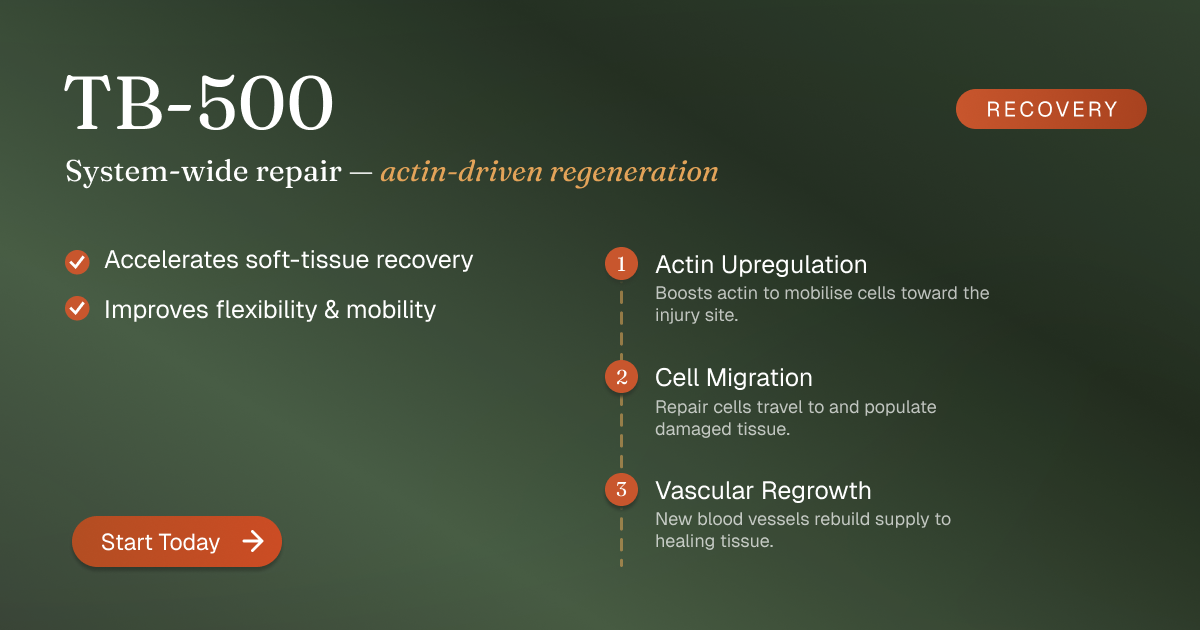
TB-500 is a synthetic analogue of the active region of Thymosin Beta-4 (Tβ4), the body's main intracellular G-actin sequestering peptide. Its core mechanism is actin regulation: by binding G-actin, it controls cytoskeletal dynamics that govern how cells migrate to injury sites. This triggers a cascade of repair activity — fibroblast and endothelial cell migration to damaged tissue, upregulation of growth factors (TGF-β, FGF-2), promotion of angiogenesis via VEGF signaling, and modulation of inflammatory cell recruitment to favor resolution over chronic inflammation. Recent metabolomics research (Rahaman et al., 2024) suggests a key metabolite, Ac-LKKTE, may mediate much of its wound-healing activity.
Personalized Peptides provides DNA-driven peptide recommendations — we are not a compounding pharmacy, peptide synthesis company, or clinical provider.
Did you know
TB-500 is based on Thymosin Beta-4, a peptide so fundamental to cellular life that it's found in virtually every cell in the human body — and when researchers knock out its gene in mice, wounds that should heal in days instead never close at all.
Preclinical Data
No human PK studies available.
No human PK for TB-500 fragment — limited TB-4 Phase I/II data
Class
Synthetic Thymosin Beta-4 active fragment
Route
SC / IM
Mol. Weight
800 Da
What we don't know
TB-500 as a commercial fragment has no published PK data. Full-length TB-4 has limited human data from RegeneRx Phase I/II trials for dry eye and venous stasis ulcers, which confirmed safety but did not report detailed PK parameters. Commercial TB-500 products vary between the heptapeptide fragment (~800 Da) and full synthetic TB-4 (~4,964 Da) — these have different PK profiles.
Why this dosing protocol
Weekly or twice-weekly dosing is biologically rational based on the sustained nature of actin-mediated tissue remodelling effects, which persist days after the peptide is cleared. Rodent protocols use 2-10mg/kg IM/SC weekly. Human dosing (5-10mg 1-2×/week) is lower than allometric scaling would suggest but is convention in wellness protocols. Combined with BPC-157 as 'The Wolverine Stack' for complementary local (BPC) + systemic (TB-500) repair mechanisms.
Empirical protocol: 5-10mg SC/IM 1-2×/week
Safety notes
- No human PK data
- Supplier variability (fragment vs full TB-4)
Pharmacokinetic data shown for educational context. All parameters are inferred or empirically derived — no formal human PK studies exist for this compound. Individual response varies. Not a substitute for clinical dosing guidance.
Benefits
What it does.
Accelerated recovery from tendon, ligament, and muscle injuries — preclinical evidence suggests it may enhance myoblast migration to injury sites and support neuromuscular junction regeneration
Reduced scarring and improved tissue remodeling — may promote matrix metalloproteinase expression and favor organized collagen deposition over fibrotic scar tissue
Anti-inflammatory without immunosuppression — may modulate inflammatory cell recruitment patterns toward resolution, potentially reducing chronic low-grade inflammation at injury sites
Cardiovascular and myocardial repair potential — preclinical porcine models suggest Tβ4 may mediate cardioprotective effects of endothelial progenitor cells following myocardial infarction
Systemic flexibility and mobility improvement — anecdotal athlete reports describe reduced stiffness and improved range of motion in chronic injury sites, consistent with TB-500's actin-mediated cellular remodeling activity (not clinically confirmed)
The science
Peer-reviewed findings.
Research supporting this compound's mechanisms and safety profile.
What this does not mean
TB-500 is a research chemical. The information on this page is educational and does not constitute medical advice, diagnosis, or treatment. TB-500 is not FDA-approved for treating injuries, tissue damage, or any other use. This page does not recommend, endorse, or prescribe any compound for human use. Always consult a qualified healthcare provider before making health decisions. Personalized Peptides provides DNA-driven educational context and test interpretation — not clinical protocols or pharmaceutical recommendations.
A Phase 1 safety study in healthy volunteers found recombinant Thymosin Beta-4 was well tolerated at both single and multiple intravenous doses, with no dose-limiting toxicities or serious adverse events reported
SOURCE · Wang et al., 2021 — Phase 1 clinical safety trial (cited in Dr. Jeffrey Peng MD clinical review, 2024)
In a clinically relevant porcine model of myocardial infarction, Tβ4 mediated significant cardioprotective effects via endothelial progenitor cells, demonstrating tissue-repair activity well beyond musculoskeletal applications
SOURCE · Peptide Biologix clinical monograph; translational porcine cardiac study
2024 metabolomics research identified that TB-500's wound-healing activity may primarily stem from its metabolite Ac-LKKTE rather than the parent compound itself — a finding that could inform more targeted next-generation formulations
SOURCE · Rahaman et al., 2024 — cited in Jeffrey Peng MD clinical review on TB-500
Protocol
How to use it.
Dosing
Loading phase: 4–6 mg per week split into 2–3 subcutaneous injections, typically for the first 4–6 weeks. Maintenance phase: 2–3 mg per week, once weekly or split into two doses. Injection near the site of injury is common practice, though subcutaneous abdominal injection is also used for systemic effect.
Cycle
Loading phase of 4–6 weeks followed by maintenance of 4–8 weeks. Standard cycling guidance: 3 months on, 6 weeks off for longer protocols. For acute injury recovery, a single 6–8 week loading cycle is common. Long-term use beyond 3 months without breaks is not recommended based on current clinical monographs.
Contraindications
When to skip it.
No FDA-approved dosing protocol for humans. Banned by WADA — prohibited in competitive sport. Theoretical concern around angiogenesis promotion in individuals with active cancers. A Phase 1 study confirmed short-term safety; long-term human data is absent. Physician supervision and cancer screening recommended before initiating any protocol.
Always cleared with your concierge before protocol start.
Regulatory Context
FDA compounding status.
| FDA Status | Risk Level | Compounding | Key Date |
|---|---|---|---|
| PCAC Review July 2026 | 🔴 At Risk | Awaiting PCAC — 503A eligibility review | PCAC July 23, 2026 |
Removed from Category 2 (Apr 23, 2026). Wolverine Stack partner to BPC-157. Under PCAC review alongside BPC-157. Same regulatory trajectory — gray zone until formal 503A listing.
Source: FDA Federal Register, PCAC agendas, industry analyses. Educational context only — not legal advice. Review after July 23-24, 2026 PCAC meeting.
Pricing
What it costs.
Indicative range for TB-500, sourced from vetted US and EU dispensing suppliers. Concierge confirms the exact figure once your match is locked.
Indicative range (USD)
Sourced through vetted dispensing partners in the United States and European Union. Concierge confirms the exact figure once your match is locked.
- 0199% purity verified, third-party tested
- 02Includes vial and reconstitution guidance
- 03Concierge supplier match included with every protocol
See TB-500 pricing — and your supplier match.
Pricing is unlocked once we know who you are. Take the 3-minute quiz and we'll match you to a US or EU dispensary based on your location and protocol fit.
- Live USD price range
- US & EU supplier shortlist
- Concierge sign-off on dosing
Indicative price range: $99–$149 USD