WEIGHT LOSS · Injectable
Retatrutide.
Triple agonist: GLP-1 + GIP + glucagon receptor



Written by Beatrisse Fender & Toby Sorabjee · Reviewed by Lynn Marie Morski
Medically reviewed October 25, 2026
How it works
Class & mechanism.
In short
Retatrutide is Eli Lilly's investigational triple-hormone peptide, activating GLP-1, GIP, and glucagon receptors together to reduce appetite and raise resting energy expenditure. Phase 3 trial data (TRIUMPH-4, Dec 2025) reported average weight loss of 28.7% at 68 weeks on the 12 mg dose — trial results, not an approved outcome. It is not FDA-approved for any indication and is not available for compounding or clinical use.
Class
Triple GLP-1/GIP/Glucagon Receptor Agonist
Mechanism
Retatrutide (LY3437943) is a synthetic peptide that simultaneously activates three hormone receptors — GLP-1, GIP, and glucagon (GCG) — with highest potency at the GIP receptor (EC50: 0.064 nM). GLP-1 and GIP receptor agonism suppresses appetite, slows gastric emptying, and enhances glucose-dependent insulin secretion, while the addition of glucagon receptor activation uniquely increases resting energy expenditure through thermogenesis and directly stimulates hepatic fatty acid oxidation and lipolysis. This triple-receptor mechanism produces a synergistic effect on caloric intake reduction, fat mobilization, and metabolic rate that exceeds the efficacy of dual or single agonists.
Personalized Peptides provides DNA-driven peptide recommendations — we are not a compounding pharmacy, peptide synthesis company, or clinical provider.
Did you know
In Phase 3 TRIUMPH-4 (Dec 2025) trial data, retatrutide's average weight loss of 28.7% at 68 weeks approached the efficacy range historically associated with Roux-en-Y gastric bypass surgery — notable trial-stage data for an investigational drug still in Phase 3. The glucagon receptor component is proposed to offset the metabolic slowdown typical of dieting by increasing calorie burning at rest, though this remains a trial-data finding, not an approved claim.
Note · Phase 2 only — population PK not yet published
Half-life
144 h
Bioavailability
80%
Tmax
60 h
Cmax
15 nmol/L
Route
SC
Molecular weight
4680 Da
Pharmacokinetic data shown for educational context. Individual response varies. Not a substitute for clinical dosing guidance.
Benefits
What it does.
In Phase 3 TRIUMPH-4 trial data, average weight loss reached 28.7% of body weight at 68 weeks on the 12 mg dose
Trial data suggest increased resting energy expenditure via glucagon receptor activation, distinct from GLP-1-only agonists
Phase 2a sub-study reported liver fat reduction of up to 86% at 12 mg, with 93% of participants reaching normal liver fat levels
Phase 3 T2D trial data show HbA1c reductions of up to 2.0%, with 82% of participants reaching HbA1c ≤6.5% in earlier Phase 2 data
Trial data reported relief from knee osteoarthritis pain and improved physical function scores in a Phase 3 sub-analysis
Trial data show favorable shifts in cardiovascular risk markers: reduced triglycerides, blood pressure, and non-HDL cholesterol
The science
Peer-reviewed findings.
Research supporting this compound's mechanisms and safety profile.
What this does not mean
Retatrutide is an investigational drug in Phase 3 clinical trials (Eli Lilly). It is not FDA-approved for any indication and is not available for compounding. The information on this page is educational and does not constitute medical advice, diagnosis, or treatment. All efficacy figures reflect clinical trial data, not approved outcomes or guaranteed results. This page does not recommend, endorse, or prescribe any compound for human use. Always consult a qualified healthcare provider before making health decisions. Personalized Peptides provides DNA-driven educational context and test interpretation — not clinical protocols or pharmaceutical recommendations.
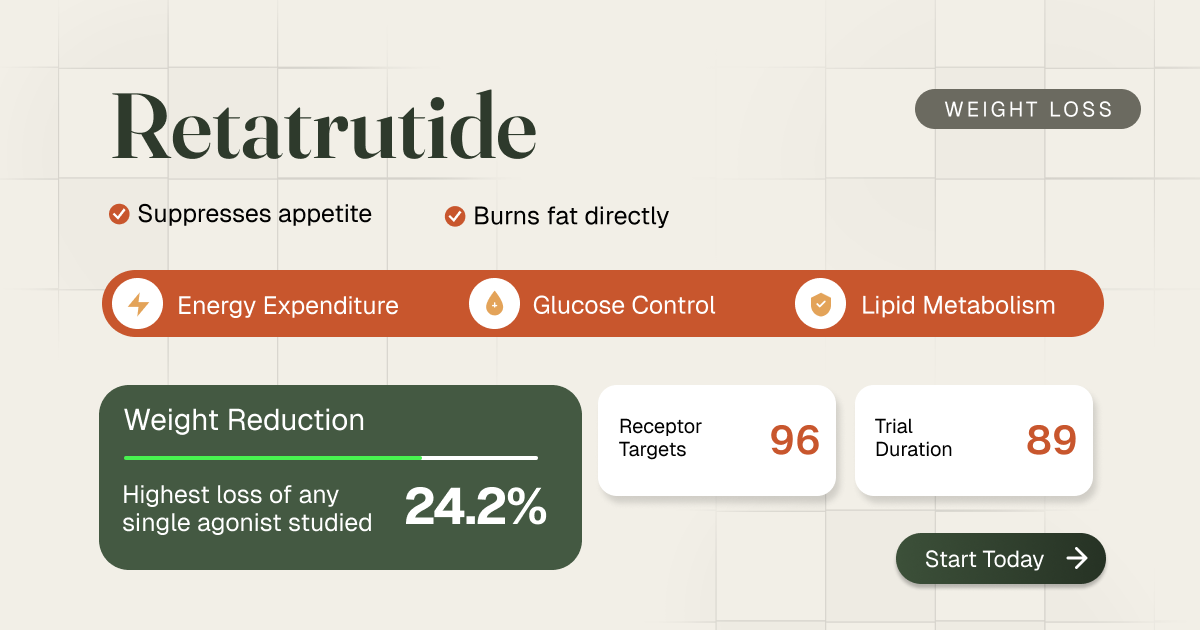
Phase 2 trial (NEJM 2023): Participants on 12 mg retatrutide lost 24.2% of body weight at 48 weeks — 100% achieved ≥5% loss, 93% achieved ≥10%, 83% achieved ≥15%
SOURCE · New England Journal of Medicine, Phase 2 RCT, 2023
TRIUMPH-4 Phase 3 trial (December 2025): Average weight loss of 28.7% (-32.3 kg / 71.2 lbs) at 68 weeks on 12 mg dose, with 14% of patients achieving complete resolution of knee pain
SOURCE · Eli Lilly TRIUMPH-4 Phase 3, December 2025
Nature Medicine Phase 2a liver sub-study (2024): 12 mg dose reduced liver fat by 86% at 48 weeks; two-to-threefold increase in beta-hydroxybutyrate indicating direct hepatic fatty acid oxidation from glucagon activity
SOURCE · Nature Medicine, Harrison et al., 2024
TRANSCEND-T2D-1 Phase 3 (March 2026): Met all primary and secondary endpoints in T2D patients — HbA1c reduced by up to 2.0% and body weight by up to 16.8% at 40 weeks vs. -0.8% and -2.5% for placebo
SOURCE · Eli Lilly TRANSCEND-T2D-1, Phase 3, 2026
Protocol
How to use it.
Dosing
Once-weekly subcutaneous injection with stepwise titration: 2 mg (weeks 1–4) → 4 mg (weeks 5–8) → 8 mg (weeks 9–12) → 12 mg (week 13+). Maximum studied dose: 12 mg/week. Titration minimizes gastrointestinal side effects during dose escalation.
Cycle
Trial protocols used ongoing weekly dosing for sustained benefit; discontinuation in trial follow-up was associated with weight regain. Phase 3 trials ran 40–68 weeks; long-term maintenance data is being collected in the TRIUMPH-Outcomes study (116-week follow-up). Retatrutide remains investigational — it is not FDA-approved and has no approved dosing regimen or indication as of this writing.
Contraindications
When to skip it.
Retatrutide is not FDA-approved and has no approved prescribing label. Based on the class-wide GLP-1/glucagon receptor agonist safety signal and trial protocols to date, personal or family history of medullary thyroid carcinoma (MTC) or Multiple Endocrine Neoplasia syndrome type 2 (MEN-2), and chronic or acute pancreatitis, have been treated as exclusion criteria in trials. Trial-reported adverse events include nausea (16–27%), diarrhea (19–26%), and vomiting (15–18%), mostly during dose escalation, with mild dysesthesia reported in 2–5% of participants that generally resolved during treatment. These are trial-population findings, not an approved safety label.
Always cleared with your concierge before protocol start.
Regulatory Context
FDA compounding status.
| FDA Status | Risk Level | Compounding | Key Date |
|---|---|---|---|
| Investigational (Eli Lilly Phase 3) | 🟡 Under Review | Not FDA-approved — investigational only | Phase 3 trials ongoing |
Triple agonist (GLP-1 + GIP + glucagon). Not FDA-approved — in Phase 3 clinical trials. Regulatory status will follow tirzepatide/semaglutide pathway once approved. Current compounding claims carry enforcement risk.
Source: FDA Federal Register, PCAC agendas, industry analyses. Educational context only — not legal advice. Review after July 23-24, 2026 PCAC meeting.
Pricing
What it costs.
Indicative range for Retatrutide, sourced from vetted US and EU dispensing suppliers. Concierge confirms the exact figure once your match is locked.
Indicative range (USD)
Sourced through vetted dispensing partners in the United States and European Union. Concierge confirms the exact figure once your match is locked.
- 0199% purity verified, third-party tested
- 02Includes vial and reconstitution guidance
- 03Concierge supplier match included with every protocol
See Retatrutide pricing — and your supplier match.
Pricing is unlocked once we know who you are. Take the 3-minute quiz and we'll match you to a US or EU dispensary based on your location and protocol fit.
- Live USD price range
- US & EU supplier shortlist
- Concierge sign-off on dosing
Indicative price range: $129–$193 USD