WEIGHT LOSS · Injectable
Adipotide.
Adipose-targeting fat loss peptide



Written by Beatrisse Fender & Toby Sorabjee · Reviewed by Lynn Marie Morski
Medically reviewed October 25, 2026
How it works
Class & mechanism.
In short
Adipotide is a research-stage peptide that homes in on blood vessels supplying white fat and triggers apoptosis in those vessels, based on a 'vascular ZIP code' discovered at MD Anderson Cancer Center. In primate and rodent studies, this produced meaningful fat and weight reduction alongside improved insulin sensitivity, but all published efficacy data comes from animal models — no completed human trials have been published. It has no approved human use and carries a documented dose-dependent renal toxicity signal in primate studies.
Class
Proapoptotic Vascular-Targeting Peptidomimetic
Mechanism
Adipotide (FTPP / CKGGRAKDC-GG-D(KLAKLAK)2) is a chimeric peptidomimetic consisting of two functional domains linked by a Gly-Gly bridge. The homing domain (CKGGRAKDC) selectively binds the prohibitin–annexin A2 receptor complex expressed exclusively on the endothelial cells of white adipose tissue vasculature — a discovery enabled by vascular ZIP code mapping at MD Anderson Cancer Center. Upon receptor-mediated internalization, the proapoptotic domain D(KLAKLAK)2 disrupts mitochondrial membranes in those targeted endothelial cells, triggering apoptosis and collapsing the vascular supply to white fat depots. Fat cells deprived of their blood supply are subsequently metabolized and reabsorbed, while the disrupted adipose vasculature also independently signals reduced food intake through a leptin-independent hypothalamic pathway.
Personalized Peptides provides DNA-driven peptide recommendations — we are not a compounding pharmacy, peptide synthesis company, or clinical provider.
Did you know
Adipotide works on a principle not used in any approved drug: in preclinical models, it targets the blood vessels that feed fat cells while sparing other vessels in the body. This 'vascular ZIP code' discovery in animal studies found that blood vessels supplying white fat carry a distinct molecular address (prohibitin receptor) — research-stage evidence suggesting fat tissue could in principle be selectively deprived of blood supply as a therapeutic strategy, though this remains unproven in humans.
Benefits
What it does.
Preclinical data show the peptide targets and induces apoptosis in white adipose tissue vasculature while sparing brown fat and other organs in the studied models
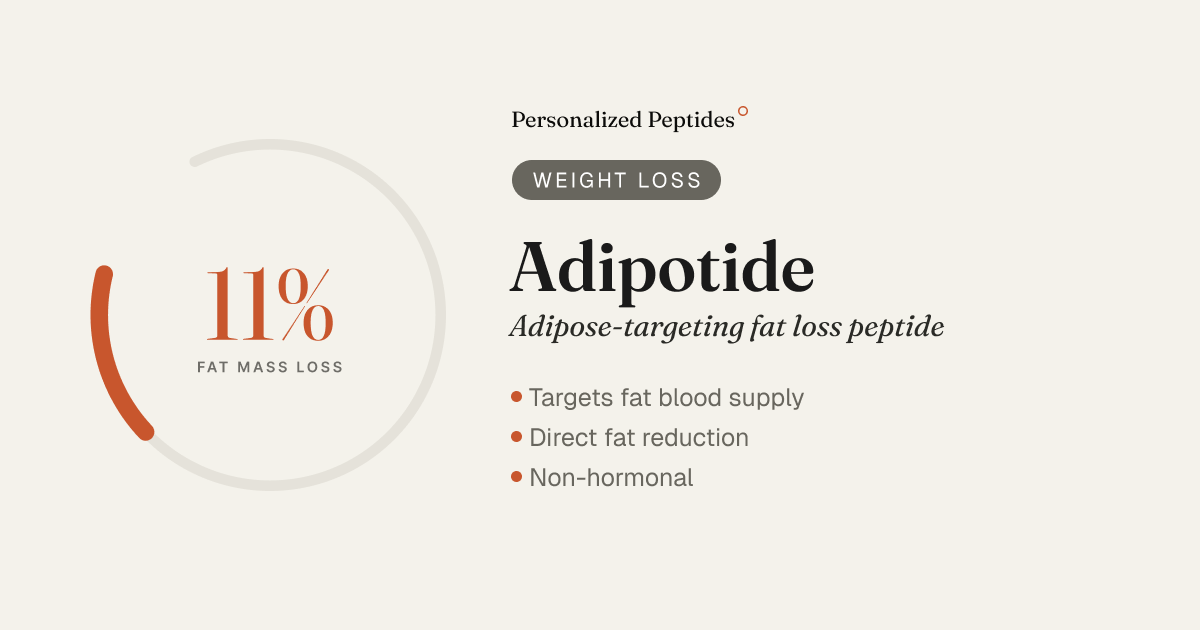
Animal-model data: ~30% body weight reduction in obese rodents over 28 days; ~11% reduction and 39% decrease in fat deposits in obese non-human primates
Primate studies reported improved insulin sensitivity — obese monkeys required ~50% less insulin after treatment
Rodent studies suggest reduced food intake via a proposed leptin-independent mechanism signaling from the altered adipose vasculature
Preclinical evidence points to selective action on visceral and subcutaneous white fat with preservation of brown adipose tissue in studied animal models
Prohibitin-targeting mechanism has generated early-stage research interest for tumor vasculature applications — no human data supports this use
The science
Peer-reviewed findings.
Research supporting this compound's mechanisms and safety profile.
What this does not mean
Adipotide is a research-stage, adipose-targeting pro-apoptotic peptide with no completed human trials published to date — all available efficacy and safety data comes from rodent and primate studies. It is not FDA-approved for any indication and is not available for compounding or clinical use. The information on this page is educational and does not constitute medical advice, diagnosis, or treatment. This page does not recommend, endorse, or prescribe any compound for human use. Always consult a qualified healthcare provider before making health decisions. Personalized Peptides provides DNA-driven educational context and test interpretation — not clinical protocols or pharmaceutical recommendations.
Barnhart et al. (2011): Adipotide induced ~11% body weight loss and ~39% fat deposit reduction in spontaneously obese rhesus macaques over 28 days, with concurrent improvements in insulin resistance — obese monkeys required ~50% less insulin post-treatment
SOURCE · Science Translational Medicine, Barnhart et al., 2011 (PMC3666164)
Kolonin et al. (2004): Targeted apoptosis of white adipose tissue vasculature via CKGGRAKDC-prohibitin binding caused ~30% body weight reduction in obese mice over 4 weeks, with normalization of metabolic processes and no significant off-target effects
SOURCE · Science, Kolonin et al., 2004
Diabetes (2010): Proapoptotic adipose vasculature peptide reduced food intake in obese rodents without changes in energy expenditure and despite falling leptin levels, revealing a novel adipose-to-hypothalamus signaling pathway
SOURCE · Diabetes, Seeley et al., 2010 (PMC2844838)
Primate GLP safety study: Three dose levels (0.25, 0.43, 0.75 mg/kg daily × 28 days) showed dose-dependent, predictable, and reversible renal tubular effects — classified as minimal to moderate kidney lesions — with no irreversible organ damage
SOURCE · GLP Primate Safety Study, Arrowhead Pharmaceuticals
Protocol
How to use it.
Dosing
Research use only. Preclinical primate efficacy protocol: daily subcutaneous injection for 28 consecutive days. Doses in primate models ranged from 0.25–0.75 mg/kg/day; efficacy balanced against renal effects at intermediate doses. No validated human dosing protocol established. All published studies used a 28-day treatment cycle followed by discontinuation.
Cycle
28-day cycles based on all published preclinical data. No published data on repeated cycles or chronic use — renal toxicity mechanism (D-amino acid oxidase metabolism in renal tubules) makes extended continuous use problematic. Clinical translation was planned for obese prostate cancer patients (28-day cycle), but no completed human trials have been published.
Contraindications
When to skip it.
Pre-clinical stage only — no approved human use. Primary safety concern is dose-dependent renal toxicity: elevated serum creatinine, tubular degeneration, single-cell necrosis, and altered tubular function observed in all primate studies. Effects were classified as reversible and predictable. Dehydration compounds kidney risk. Not suitable for patients with pre-existing renal impairment. Does not affect brown adipose tissue, lean mass, or organ vasculature at studied doses.
Always cleared with your concierge before protocol start.
Regulatory Context
FDA compounding status.
| FDA Status | Risk Level | Compounding | Key Date |
|---|---|---|---|
| No specific FDA action | 🟢 Stable | Gray zone — no specific enforcement | No pending dates |
Adipose-targeting pro-apoptotic peptide. Not on any FDA Category 1/2/3 lists. No pending PCAC review. Experimental compound — limited human data. Research-stage.
Source: FDA Federal Register, PCAC agendas, industry analyses. Educational context only — not legal advice. Review after July 23-24, 2026 PCAC meeting.
Pricing
What it costs.
Indicative range for Adipotide, sourced from vetted US and EU dispensing suppliers. Concierge confirms the exact figure once your match is locked.
Indicative range (USD)
Sourced through vetted dispensing partners in the United States and European Union. Concierge confirms the exact figure once your match is locked.
- 0199% purity verified, third-party tested
- 02Includes vial and reconstitution guidance
- 03Concierge supplier match included with every protocol
See Adipotide pricing — and your supplier match.
Pricing is unlocked once we know who you are. Take the 3-minute quiz and we'll match you to a US or EU dispensary based on your location and protocol fit.
- Live USD price range
- US & EU supplier shortlist
- Concierge sign-off on dosing
Indicative price range: $124–$186 USD